Environment & Energy
Related: About this forumClose to 30% of cars sold this year are set to be electric as countries and consumers respond to energy crisis
https://www.iea.org/news/close-to-30-of-cars-sold-this-year-are-set-to-be-electric-as-countries-and-consumers-respond-to-energy-crisis20 May 2026
New report finds robust momentum for EVs in 2025, with record sales in nearly 100 countries, and potential for current crisis to lead to further growth in key markets
After strong growth last year, global electric car sales are expected to rise again in 2026, reaching 23 million and accounting for close to 30% of all cars sold worldwide, according to the new edition of the IEA’s annual Global EV Outlook.
The report, out today, examines key market and policy trends related to the deployment of electric vehicles and charging infrastructure, as well as the implications of growing EV adoption for electricity, oil and emissions. Amid the major energy crisis stemming from the war in the Middle East, the new Outlook also presents initial data for the early months of 2026 and considers the consequences of the crisis for EV policy and market development.
In 2025, global electric car sales grew by 20% to exceed 20 million, meaning that a quarter of all new cars sold worldwide were electric. In around 40 countries, electric cars accounted for 10% or more of new cars sold. In terms of production, Chinese automakers supplied 60% of electric cars sold worldwide, while European and North American automakers were each responsible for about 15% of global sales.
Following policy changes in China and the United States, global sales of electric cars in the first quarter of 2026 fell by 8% compared with the same period in 2025. However, this overall decline masked strong sales growth in many other countries and regions. In Europe, sales increased by close to 30% year-on-year; in the Asia Pacific region excluding China, sales jumped by 80%; and in Latin America, they were up by 75%. In March, close to 90 countries around the world logged year-on-year sales growth, with around 30 of them registering record-breaking monthly sales.
…
 = new reply since forum marked as read
Highlight:
NoneDon't highlight anything
5 newestHighlight 5 most recent replies
= new reply since forum marked as read
Highlight:
NoneDon't highlight anything
5 newestHighlight 5 most recent replies

KT2000
(22,223 posts)that the fossil fuel industry has its foot on our necks and alternative will free us.

Fiendish Thingy
(24,098 posts)Just like in the 70’s with the gas shortages, makers were forced to improve mileage.

MichMan
(17,396 posts)They tax gasoline much higher than we do here. The average price per gallon in Germany for example is $8.74 plus a 19% VAT, making it just over $10 per gallon.
Had someone here had the political will to raise US gas taxes a similar amount, US consumers would have been demanding EV without the need for subsidies.

OKIsItJustMe
(22,140 posts)In the 70’s, in response to the “Oil Crisis,” imported vehicles (especially from East Asia/Japan) became very popular in comparison with the “Detroit ‘Gas Guzzlers.’” High EPA gas mileage ratings were a feature.


flvegan
(66,528 posts)the conversion in the used car market (someone trades their ICE for a used EV). Considering the depreciation in the EV market, I'll bet this is an interesting* number.
*Interesting also because I'm on the hunt in that conversion market right now.
OKIsItJustMe
(22,140 posts)Last edited Wed May 20, 2026, 11:03 PM - Edit history (1)
Please note, contents taken from a “Creative Commons” source:IEA (2026), Global EV Outlook 2026, IEA, Paris https://www.iea.org/reports/global-ev-outlook-2026, Licence: CC BY 4.0
The used car market could provide an important avenue for affordability
The most common way to buy a car is second-hand
Second-hand markets play a central role in enabling mass-market adoption of electric cars. Most people do not buy new cars; instead, they buy used cars because upfront costs are lower, making car ownership more affordable. For example, across Europe around eight in ten people purchase their car second-hand, and this share rises to roughly nine in ten among low- and middle-income households.
Besides increasing affordability for individual owners, the second-hand car market is important for fleet operators and leasing companies, which purchase large volumes of new cars and rely on stable residual values to manage costs and risks. In general, the price of a lease is designed to account for the depreciation of a vehicle over the typical 3-year lease period. Predictable resale values for electric cars, on par with those of conventional cars, help stimulate new electric car registrations, support fleet turnover, and increase the supply of affordable used vehicles entering the market following their first lease.
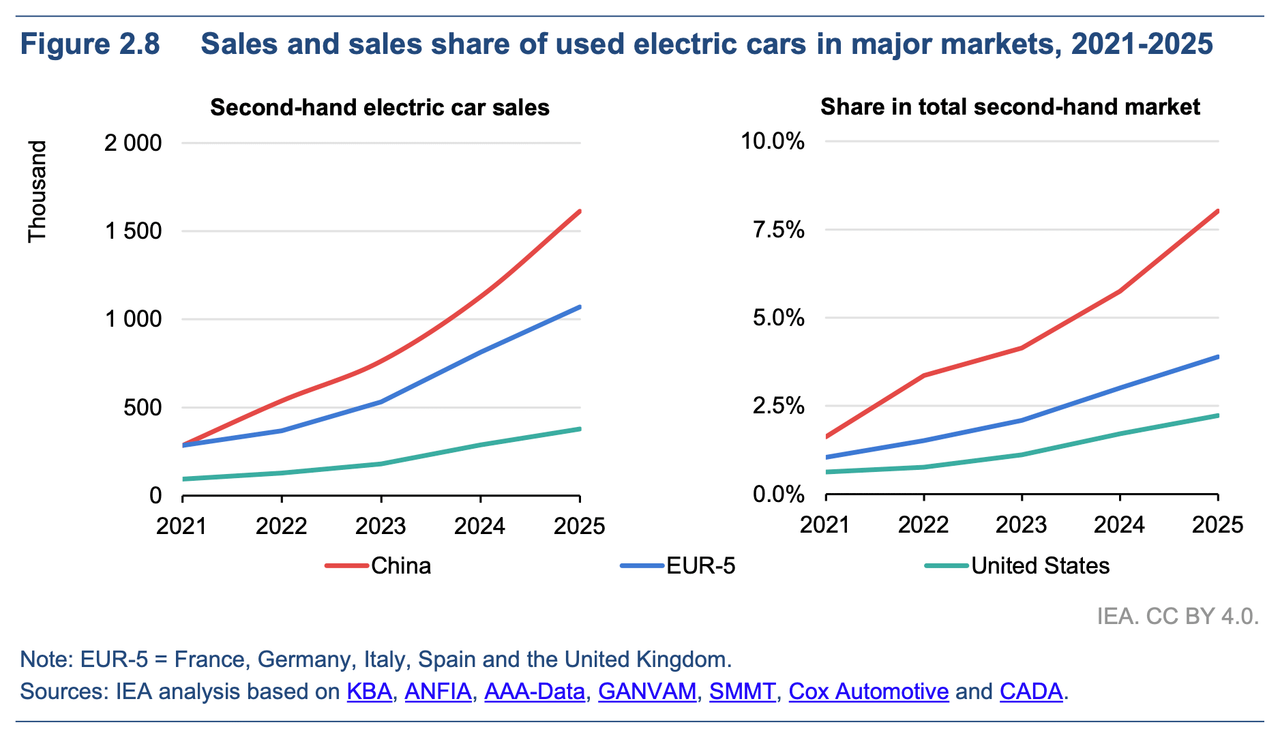
Over the past few years, the share of electric cars in the second-hand market has grown steadily across major regions. Across China, five key European markets (France, Germany, Italy, Spain and United Kingdom) and the United States, sales of used electric cars surpassed 3 million in 2025, an increase of around 35% compared with 2024.
Resale values in China are taking a hit from new, cheaper models
With around 13% of China’s car fleet now electric, the second-hand market is also becoming increasingly electrified. In 2025, sales of used electric cars exceeded 1.5 million, around 8% of all used car sales, reflecting strong new car uptake in recent years and large numbers of electric cars cycling out of initial ownership for the first time. Turnover was also supported by the scrappage and trade-in scheme (see Chapter 1), in which a subsidy of up to CNY 15 000 (Yuan renminbi) (USD 2 000) is provided if a new electric car is bought to replace an older car, CNY 2 000 (USD 275) more than the subsidy received when buying a new conventional car.
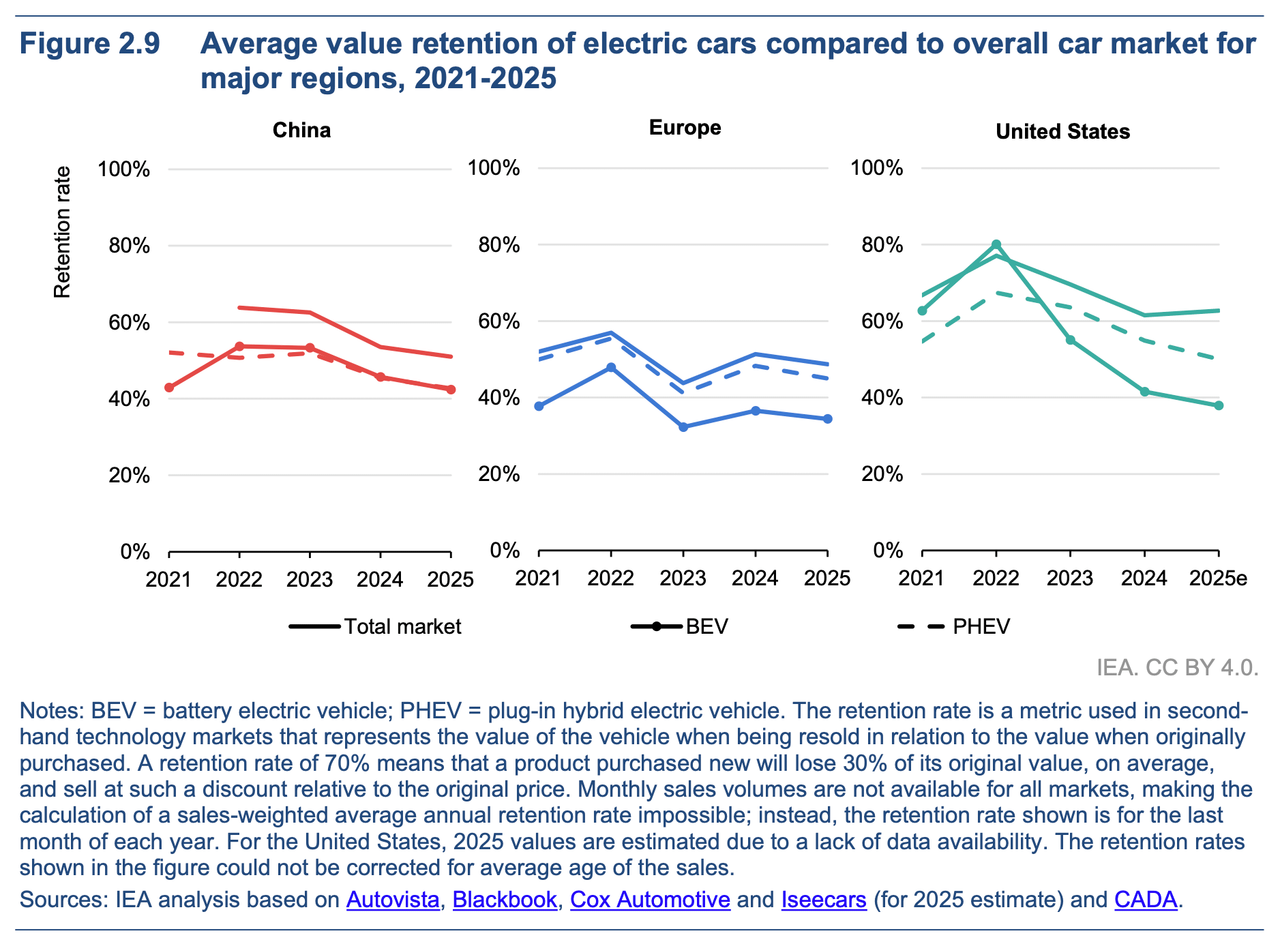
In 2024, the levels of electric car resale value retention were lower than the overall levels in China – about 46% for 3-year-old electric cars, compared to around 55% across the broader used car market. By late 2025, average BEV and PHEV resale values had fallen to 42%, a similar percentage point decrease as in the overall used car market, where levels declined to just above 50%. There are several reasons for the difference in depreciation rates between electric and ICE cars in China. Rapid advances in battery technology have quickly made newer electric models far more attractive, accelerating the depreciation of older electric cars. While electric cars generally require less routine maintenance than conventional cars, concerns about battery health and the potential cost of major repairs make the purchase of an older electric car less appealing. So much so that it is estimated that around 80% of used car dealers in China now refuse to accept BEVs that are more than 5 years old.
In Europe, resale values for battery electric cars have decreased since 2022 as supply and demand balanced out
In Europe, only around four in ten of all new car registrations are made by private buyers, while the majority are purchased by company fleets, dealerships or short-term rental firms. As the share of private buyers has steadily declined over the past decade, the choices made by corporate fleets have become increasingly influential, shaping the pace and direction of Europe’s fleet build-up. Across the five European markets analysed – France, Germany, Italy, Spain and the United Kingdom – electric cars represented roughly 4% of used car transactions in 2025, increasing from only 1% in 2021.
Market conditions differ across countries. The United Kingdom remains the largest overall second-hand market among the five, with sales of nearly 8 million used cars in 2025. Meanwhile, Germany recorded the highest sales of used electric cars by volume – around 400 000 – in 2025, corresponding to a little over 6% of the country’s used car market.
In 2022, tight supply of used cars lifted resale values across all powertrains in the five European countries analysed. As supply and demand have since rebalanced, overall value retention has declined. However, the value retention of BEVs has weakened more noticeably. Across the five markets, battery electric car retention rates fell from a peak of about 50% in 2022 to 35% in 2025, compared with the overall market’s drop from around 60% to 50%. PHEVs show a similar pattern: While PHEVs were broadly aligned with average resale values in 2022, their performance began to diverge from 2023 onwards. The steepest decline was observed in Germany, where PHEV retention rates matched that of the overall market in 2022 but fell to an average of 45% by the end of 2025, around four percentage points below the market average.
US second-hand electric car market remains volatile
The United States remains the smallest used electric car market among the regions analysed, with less than 400 000 electric car transactions in 2025, representing roughly 2.5% of all used car sales. Despite the market’s limited size, activity accelerated last year, as 2025 marked the final year of eligibility for federal tax rebates on second-hand EVs (see below), contributing to a 30% increase in used EV sales compared with 2024. Tesla continued to dominate the segment, securing three of the top five positions in the ranking of used EV models sold in the United States. About 40% of used EVs sold for under USD 25 000, significantly less than a new electric car in the United States (see above), with a used Nissan LEAF remaining one of the most accessible models, priced at about USD 12 000.
Resale values in the United States have been highly volatile compared with other major markets. In 2022, BEV resale values outperformed the overall used car market, reflecting the limited availability of electric models at the time. This trend reversed sharply in 2023 following Tesla’s price cuts for new cars, which rapidly eroded used EV pricing. By mid-2025, BEV resale values had fallen further amid a rush to capitalise on the expiring tax incentives for second-hand cars, which provided a tax rebate of USD 4 000 for used vehicles priced below USD 25 000. In contrast, overall used car prices increased, driven in part by tariff-related cost pressures. As a result, BEV resale values ended 2025 roughly 25 percentage points below the overall market.
…

lostincalifornia
(5,538 posts)alternative fuels, but HIS self-induced war with Iran has actually caused the opposite effect the increase of energy prices.
All the SOB in the WH had to do is just take the Iran nuclear deal that President OBAMA negotiated, and continue where it left off. Instead, the idiot unlaterally disbanded the agreement, and is directly responsible for the chaos he has single handedly created.
OKIsItJustMe
(22,140 posts)For example, he kept claiming he hadn't heard the “secret words,” "We will never have a nuclear weapon.””
Iran has said for decades that nuclear weapons (and any other "weapons of mass destruction") are against Islam.
https://en.wikipedia.org/wiki/Fatwa_against_nuclear_weapons

Kick in to the DU tip jar?
This week we're running a special pop-up mini fund drive. From Monday through Friday we're going ad-free for all registered members, and we're asking you to kick in to the DU tip jar to support the site and keep us financially healthy.
As a bonus, making a contribution will allow you to leave kudos for another DU member, and at the end of the week we'll recognize the DUers who you think make this community great.