Welcome to DU!
The truly grassroots left-of-center political community where regular people, not algorithms, drive the discussions and set the standards.
Join the community:
Create a free account
Support DU (and get rid of ads!):
Become a Star Member
Latest Breaking News
Editorials & Other Articles
General Discussion
The DU Lounge
All Forums
Issue Forums
Culture Forums
Alliance Forums
Region Forums
Support Forums
Help & Search
Environment & Energy
Related: About this forum
Um, delicious!!! Recovery of Highly Toxic Tellurium Used for Super Efficient Solar Cells.
The paper I'll discuss briefly in this post is this one: Adsorption and Recovery of Tellurium from Aqueous Solutions Using Calcined Mg–Al Layered Double Hydroxide Adsorbent Umama Rashid Lamiya, David J. Shoemaker, Xiaobo Lei, Samia Alam, William E. Holmes, Jonathan Raush, Mark E. Zappi, and Daniel Dianchen Gang Industrial & Engineering Chemistry Research 2026 65 (11), 6196-6208.
I won't have much time to spend on this paper, but I thought some excerpts would be in order, since, as we have antinukes around here in praise of lead based perovskites for solar cells, being indifferent to issues in the toxicology of distributed pollutants, maybe we can add affection for tellurium to it.
From the introductory text:'
Tellurium (Te) is a rare metalloid that has remarkably low concentration (approximately 1–5 ppb) in Earth’s crust, which is even lower than platinum, gold, and silver. (1,2) This element has received growing recognition in the 21st century owing to its wide range of applications in solar panels, (3) semiconductors, (4) gas sensor construction, (5) thermoelectric materials production, (6) and metallurgy as an alloying component. (7) The use of cadmium telluride (CdTe) photovoltaic (PV) cells in solar panels has brought a revolutionary change in the energy industry (8) because of their relatively low expense, strong performance, and high environmental benefits. Every gigawatt-hour of photovoltaic-generated electric power would avoid the emission of up to 1000 tons of carbon dioxide (CO2), 4 tons of nitrogen oxide (NOx), 0.7 tons of particulates (including 120 kg of As and 1 kg of Cd), and 10 tons of sulfur dioxide (SO2) as compared to burning coal for power production. (3) A range of photovoltaic materials has been used as renewable energy sources, including monocrystalline silicon, (9) polycrystalline silicon, (10) copper indium gallium selenide, (11) gallium arsenide, (12) single-walled carbon nanotubes, (13) and cadmium telluride thin films. (14) However, due to economically viable manufacturing, (15) significant built-in voltage, low thermal loss, (16) optimal band gap (1.45 eV), battery stability, and high (16.5%) energy conversion capability (17) compared to other PV materials, CdTe is arousing substantial interest...
I added the bold for commentary. First off, the element is rarer than platinum, gold and silver. It's a good thing that the solar industry is trivial and useless form of energy, because if it weren't, and were to depend on an element rarer than these elements, well, one can draw one's conclusions about cost.
Of course, platinum, gold and silver are not toxic; they are inert elements, but we'll turn to that below. Cadmium, selenium, arsenic, indium and tellurium are not; they are all toxic, very toxic.
Even though the text, rare for the solar scam, uses a unit of energy, in this case the gigawatt-hour to describe solar energy - rare since most of the liars representing this junk as "green" use units of power (Watts) as if solar cells ever reached their peak power for more than a few minutes in a 24 hour period (this is rare) the comparison with coal is nonsense. Coal is the dirtiest of all energy sources, but the reason it remains a major source of primary energy is that it is reliable, something solar energy is not and never will be, owing to a widely reported phenomenon known as "night." Decades of toxic battery and idiotic hydrogen bullshit have not addressed this flaw, and never will.
The only form of primary energy that is more reliable than coal is nuclear energy. As I pointed out recently, the top 30 most reliable large scale power plants in the United States are all nuclear plants, the next most reliable plants are generally coal plants:
Sorted by capacity utilization, a list of the largest power plants in the United States.
Solar and wind plants are notoriously unreliable, which is why the cost of solar and wind energy - often misrepresented as "cheap" - is actually responsible for high electricity rates once the requirement for redundant plants is included, the LFSCOE as opposed to LCOE, the latter as inherently dishonest as the view that a Watt is the same as a Joule.
The only form of energy that is more reliable than coal is nuclear energy, which advocates of solar energy hate, having no interest whatsoever in the use of fossil fuels, about which they couldn't care less.
There is no "revolutionary change" connected with solar PV energy. It is a trivial form of energy; after the expenditure of trillion dollar sums on it, as of 2024, it produced just 9 Exajoules out of the 2024 worldwide energy demand of 654 Exajoules, actually growing by 1 Exajoule over 2023, slower than the growth of coal, gas and petroleum, about which, again, antinukes couldn't care less.
Both cadmium and tellurium are toxic elements, a point the paper makes with respect to tellurium:
Additionally, this expansion in CdTe PV cell production has resulted in a corresponding increase in the level of PV waste. By 2050, the overall quantity of waste PV modules is expected to reach approximately 78 million tons, and a significant portion of this will contain CdTe cells. (20) This waste can pose a severe threat to the aquatic environment and human health if it gets into the soil and water through landfill leachate and other ways. (16) Naturally, through the weathering and dissolution of Te-rich rocks and deposits, volcanic eruption, and hydrothermal activity, Te can end up in freshwater (less than20 ng/L) and seawater (less than2 ng/L). (21) Tellurium is usually present in a few μg/kg in most crustal rocks; however, hydrothermal fluids and vapors can increase the concentration to above mg/kg. Besides, mining, burning coal, smelter emissions, and Te-rich industrial wastewater are the man-made sources of tellurium into the soil and water. (22)
If ingested, tellurium can accumulate in the kidney, bone, heart, lungs, and spleen, potentially leading to irreversible degenerative effects on these organs. (23) In nature, Te can be present in several forms, including tellurate (TeO42–, Te(VI)), tellurite (TeO32–, Te(IV)), elemental tellurium (Te0), organic dimethyl telluride (CH3TeCH3), and inorganic telluride (Te2–). (24) Among these, tellurium oxyanions pose significant toxicity, while tellurite shows nearly ten times the toxicity of tellurate. (25) To control Te contamination in the environment and meet the worldwide increasing demand for Te as a renewable energy resource for achieving the clean energy goal, it is crucial to develop economic and sustainable tellurium recovery methods.
If ingested, tellurium can accumulate in the kidney, bone, heart, lungs, and spleen, potentially leading to irreversible degenerative effects on these organs. (23) In nature, Te can be present in several forms, including tellurate (TeO42–, Te(VI)), tellurite (TeO32–, Te(IV)), elemental tellurium (Te0), organic dimethyl telluride (CH3TeCH3), and inorganic telluride (Te2–). (24) Among these, tellurium oxyanions pose significant toxicity, while tellurite shows nearly ten times the toxicity of tellurate. (25) To control Te contamination in the environment and meet the worldwide increasing demand for Te as a renewable energy resource for achieving the clean energy goal, it is crucial to develop economic and sustainable tellurium recovery methods.
Oh well then.
Tellurium is, I confess, a fission product. Roughly, over more than 70 years, about 80,000 tons of used nuclear fuel has been collected in the United States, still, for the next two years until China over takes it, the world's largest producer of nuclear energy. Of this, ignoring the zirconium cladding, about 95% represents unreacted uranium available for recovery and reuse, and about 1-2% is plutonium with traces of the higher actinides americium and curium, as well as traces of the lower actinide neptunium. Of the remaining fission products 3 to 4%, tellurium represents 1% meaning that all of the tellurium in valuable used nuclear fuel is at maximum, 80,000 X 0.04 X 0.01 = 32 tons, considerably shy of 78 million tons of solar waste. All of the radioactive isotopes of tellurium found in used nuclear fuel have short half-lives and tellurium isolated from used nuclear fuel a decade or so old will be perfectly suitable for use in say, thermoelectric devices localized in industrial settings, although I wouldn't recommend it as a consumer item.
The authors continue:
Tellurium is predominantly found in association with other ores (pyrite, chalcopyrite, gold, tin, etc.), apart from a single independent deposit, (26) and extracted during smelting. (27) Current tellurium separation techniques mainly include hydrometallurgy (leaching, purification, deposition), pyrometallurgy (preparation, roasting, smelting, refining), or their combination. (28) However, these methods are expensive, energy-intensive, have low selectivity, and generate hazardous secondary wastes. (29) Yet, these methods are oriented toward nonaqueous media, with very little technology available for the recovery of Te from water solutions.
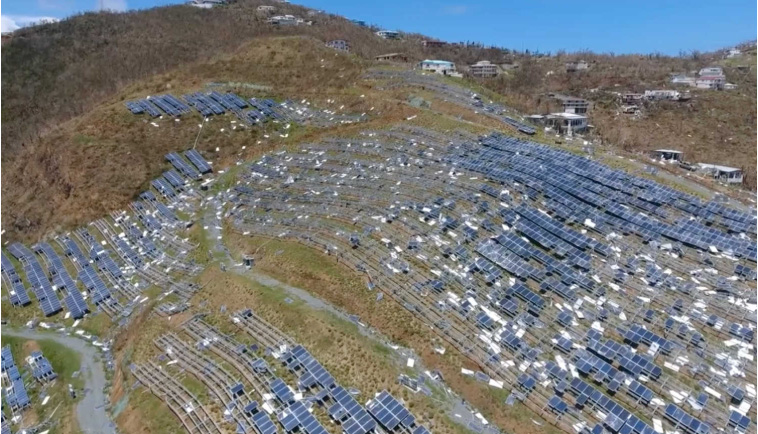
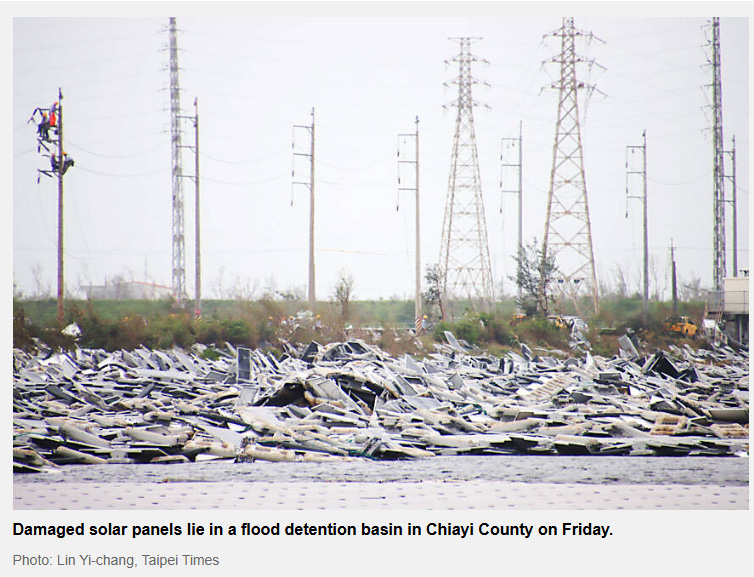
Don't worry, be happy. There are plenty of people around here to tell you that solar energy is "green" and that we should tear the shit out of vast tracts of wilderness to make industrial plants that will be electronic waste is about 25 years, assuming that stuff like this doesn't happen:
From Inside Climate News:
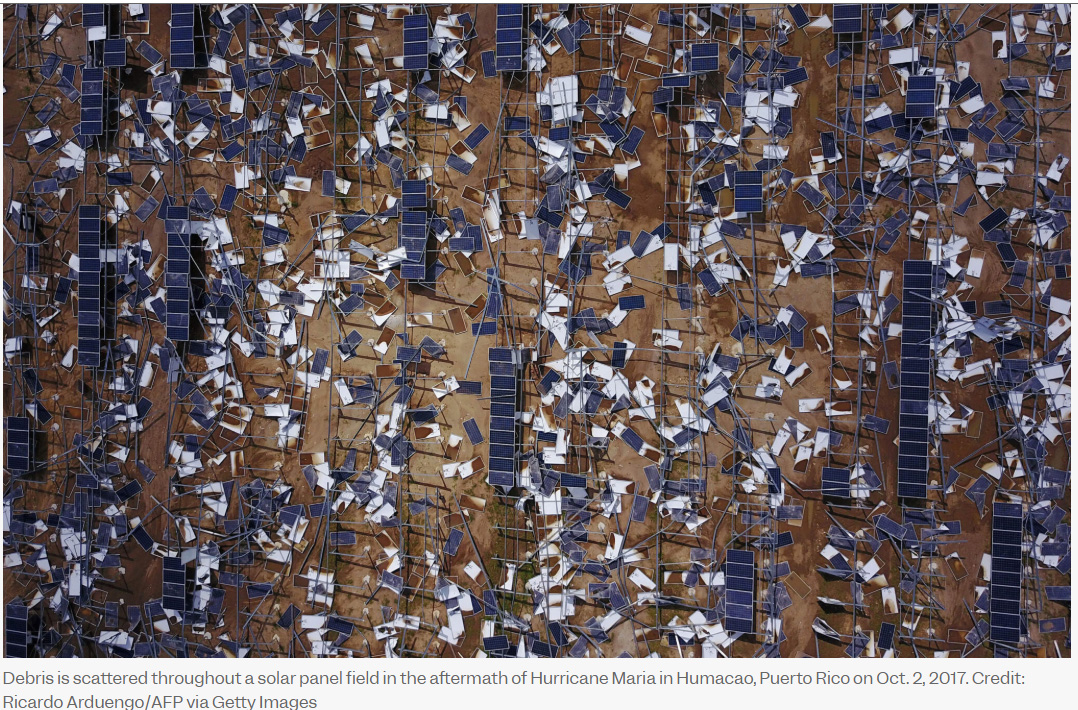
Virgin Group Company BMR Energy Announces Plans to Rebuild St. Thomas Solar Farm
Renew Economy:

Solar groups deny damage, pollution claims after Danas
(There's reference to denial again.)
Why the solar revolution is in grave danger—and how it can be saved
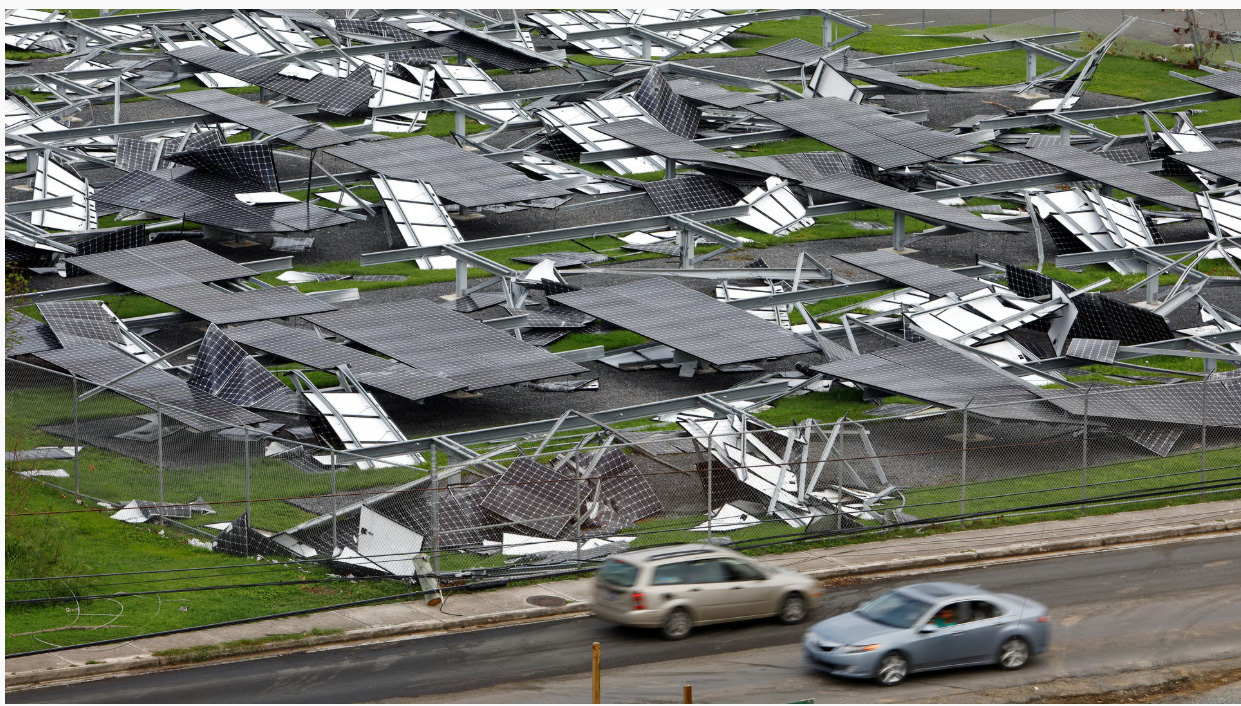
Um, delicious.
Have a nice weekend.