Environment & Energy
Related: About this forum
New solar cells hit 30% efficiency and still work after 1,000 hours of power

New solar cells hit 30% efficiency and still work after 1,000 hours of power
The team developed a chemical-hardness strategy to control crystal growth.
Georgina Jedikovska | interestingengineering.com | May 07, 2026
Chinese scientists have pushed perovskite tandem solar cells past the critical 30 percent efficiency mark after developing a new way to control how the materials crystallize during manufacturing.
The research team was led by Ge Ziyi, PhD, and Liu Chang, PhD, from the Ningbo Institute of Materials Technology and Engineering (NIMTE), under the Chinese Academy of Sciences (CAS). The team hit a certified power conversion efficiency of 30.3 percent in rigid all-perovskite tandem solar cells, and 28 percent in flexible versions.
They believe that the achievement can speed up the development of lightweight, high-efficiency solar technologies that are far cheaper and easier to manufacture than traditional silicon-based panels.
“The findings provide a pathway to simultaneously improve efficiency and durability in both rigid and flexible devices, thereby advancing the development of lightweight, scalable photovoltaic technologies,” the scientists pointed out...more
https://interestingengineering.com/energy/all-perovskite-solar-cell-efficiency-past-30
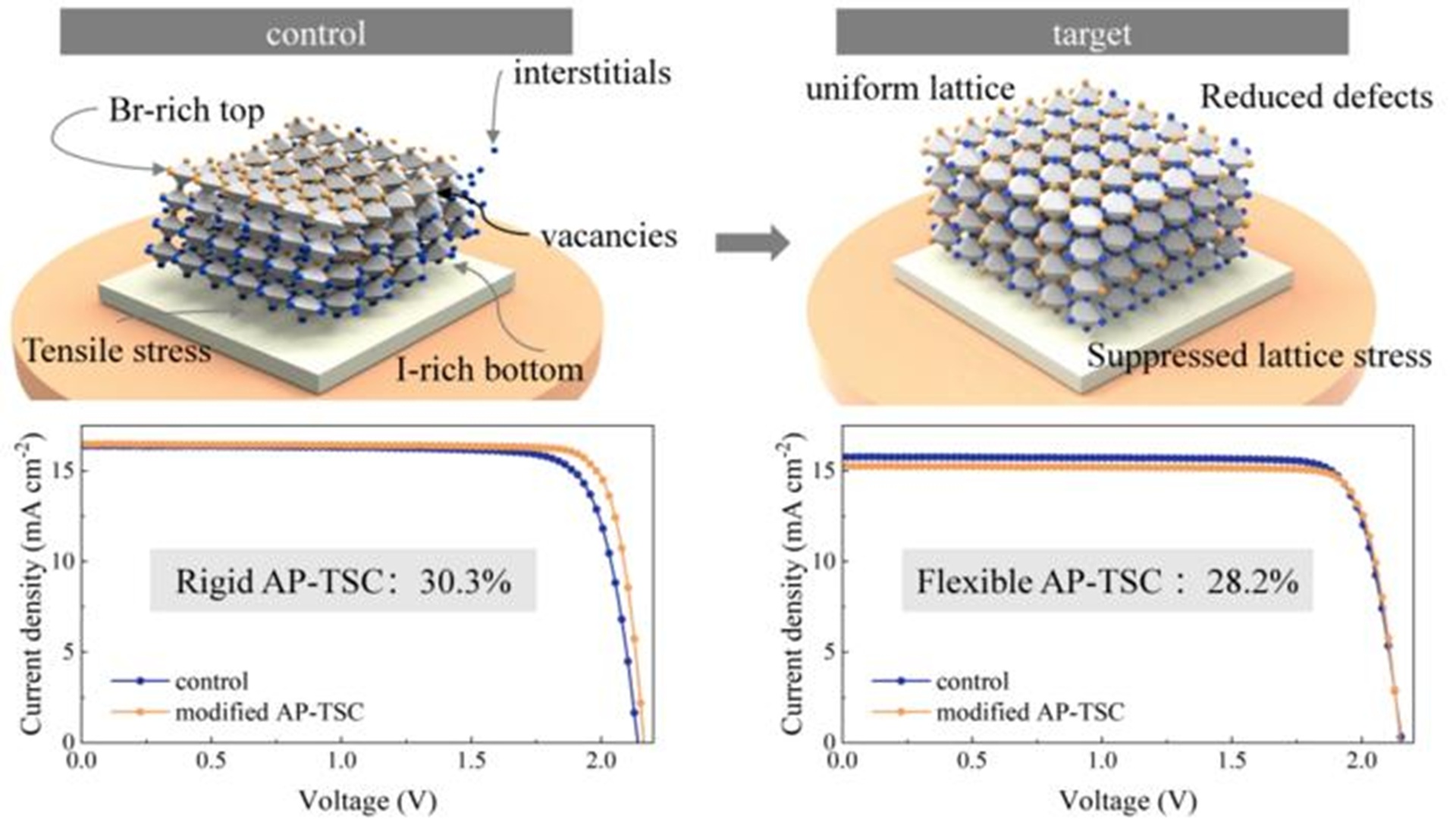
The study has been published in the journal Nature Nanotechnology.
Chemical hardness engineering synchronizes crystallization in perovskite tandems
Abstract
All-perovskite tandem solar cells are constrained by asynchronous crystallization in multicomponent perovskites, which produces vertical compositional gradients, structural inhomogeneity and excessive non-radiative recombination. These effects arise from mismatched coordination and crystallization kinetics among mixed halides and Pb2+/Sn2+ cations...
The government’s own data rebuts Trump’s claims about wind and solar prices
As of late 2025 and early 2026, President Donald Trump has consistently criticized solar and wind energy, calling them a "scam of the century" and "farmer destroying," often blaming them for rising electricity costs, according to AP News and Facebook/Washington Post. These claims are frequently deemed inaccurate, as experts state renewables are often the cheapest energy source, and analysts attribute price hikes to infrastructure issues...
And some call solar/wind "JUNK". LOL
 = new reply since forum marked as read
Highlight:
NoneDon't highlight anything
5 newestHighlight 5 most recent replies
= new reply since forum marked as read
Highlight:
NoneDon't highlight anything
5 newestHighlight 5 most recent replies

eppur_se_muova
(42,383 posts)
NNadir
(38,472 posts)Most perovskites are lead based, offering the world an opportunity to match leaded gasoline and coal for uncontrolled lead distribution in the environment.
Of course there has never been an antinuke who gives a shit about the toxicology of fossil fuels, which is why some of them come around here pushing coal based hydrogen in China with a dishonest representation that hydrogen there is "green." (Chinese scientists have not invented a way to label flowing electrons by source, since doing so is impossible, nor have they demonstrated a means to prevent the daily occurrence of something called "night." )
I often consider that the distribution of lead, a neurotoxin, may account for the intellectual level of antinukes, but I'm only guessing at that.

OKIsItJustMe
(22,046 posts)Jang, W.J., Park, P.J., Ong, WJ. et al. Stable and eco-friendly inorganic lead-free perovskite solar cells: structural, electronic, and defect engineering. Commun Mater 7, 110 (2026). https://doi.org/10.1038/s43246-026-01158-1
Open access
Published: 15 April 2026
Stable and eco-friendly inorganic lead-free perovskite solar cells: structural, electronic, and defect engineering
Won Jin Jang, Pil Ju Park, Wee-Jun Ong & Soo Young Kim
Communications Materials volume 7, Article number: 110 (2026)
Abstract
Inorganic lead-free halide perovskites are emerging as promising candidates for stable and environmentally responsible photovoltaic technologies. Replacing volatile organic cations and toxic lead with robust inorganic constituents enables improved thermal and chemical resilience while preserving favorable optoelectronic properties. This review provides a comparative assessment of representative inorganic lead-free perovskites, highlighting how their structures, electronic configurations, and defect chemistry govern carrier generation and transport. By integrating insights from crystallographic stability and interfacial electronic structure, we outline the key principles that underpin efficient device operation. We further identify the remaining challenges that must be addressed to enable competitive performance, including defect management, controlled crystallization, scalable film formation, and reliable long-term stability under coupled stress conditions. Building on these considerations, we propose future directions to guide the rational design of durable, high-performance inorganic lead-free perovskite solar cells.
…

…
The timeline for the advances in perovskite solar cells has been remarkable. A little over a decade ago, they had single digit efficiencies, and worked for hours (or less) before failing. They’re still "not ready for 'prime time,’” but how long have “Gen-IV” reactors been being developed? (still waiting… 🥱)
While we’re waiting, let’s deploy what works, today.