Welcome to DU!
The truly grassroots left-of-center political community where regular people, not algorithms, drive the discussions and set the standards.
Join the community:
Create a free account
Support DU (and get rid of ads!):
Become a Star Member
Latest Breaking News
Editorials & Other Articles
General Discussion
The DU Lounge
All Forums
Issue Forums
Culture Forums
Alliance Forums
Region Forums
Support Forums
Help & Search
Environment & Energy
Related: About this forumJames Hansen et al -- 2026 On Track for Warmest Year
http://www.columbia.edu/~jeh1/mailings/2026/2026GlobalTemperature.2026.04.30.pdf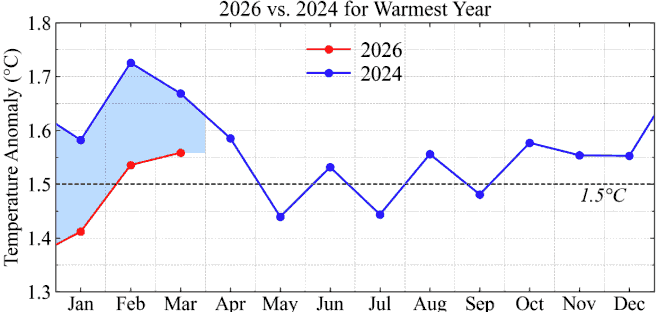
Fig. 1. Global surface temperature anomaly in GISS analysis ¹ relative to 1880-1920 mean.
2026 On Track for Warmest Year
30 April 2026
James Hansen, Pushker Kharecha, Dylan Morgan and Jasen Vest
Abstract. We infer that 2026 is likely to be the warmest year in the period of instrumental data, based on a physics-based approach with identifiable assumptions. This approach may help us learn something in 2026 about the mechanisms of climate change.
The figures in this post and our other current papers will be continually updated on our website, ² when they remain relevant. We are also now on Substack³ .
A Carbon Brief article last week (“Strong El Nino Puts 2026 on Track for Second Warmest Year”) ⁴ makes us wonder about the basis for such expert projection. We are reminded of IPCC (Intergovernmental Panel on Climate Change) expert projections with unstated assumptions and whose physical basis is inscrutable to the public. Organized climate model runs for the Climate Model Intercomparison Project (CMIP) are valuable for climate analyses, but the fog of all model results should not be misinterpreted as a probability distribution for the real world.
As an alternative, let’s try a physics-based approach, with the hope to learn something from it by the end of the year. Specifically, let’s assume that the budding El Nino will have strength at least comparable to the 2023-24 El Nino. We assume that global temperature change is caused by climate forcings (imposed changes of the planet’s energy balance) and that “Nino” variability is the only substantial source of global “noise,” i.e., unforced global temperature change.
Why is this exercise of interest? Because, as we discussed in prior posts, the main issue is not El Nino, but the need to understand accelerated warming, unprecedented marine heat waves, and increasing climate extremes. The high rate of global warming acceleration was not anticipated by IPCC because their best estimate for climate sensitivity (3°C for 2×CO₂ ) was an underestimate. We have shown in four independent ways, with greater than 99% confidence, that climate sensitivity is substantially higher, 4-5°C for doubled CO₂ . ⁵ IPCC compensated for low climate sensitivity by failing to recognize that aerosol cooling increased during 1970-2005. Since then, especially since 2015, a reduction of aerosols and their cooling effect has caused the decadal growth rate of net climate forcing to be about double what it was in 1970-2005. ⁶ This increased net forcing combines with high climate sensitivity to cause recent global warming acceleration.
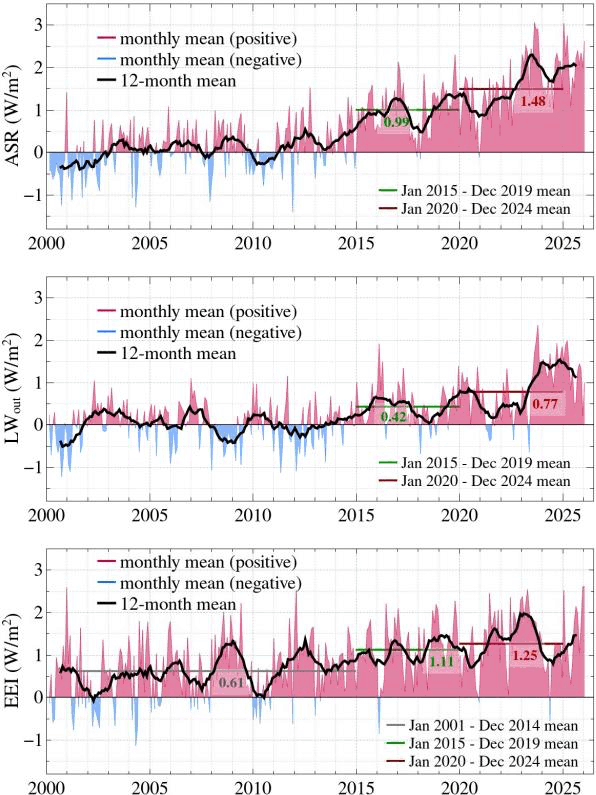
Fig. 2. Earth’s satellite-observed absorbed solar radiation (ASR) and longwave (thermal) emission to space (LW), ⁷ both relative to their 2000-2010 averages, and the absolute Earth energy imbalance (EEI) calibrated with aid of Argo-measured heat storage in the ocean.⁸
…
I strongly encourage you. to read the entire PDF.
3 replies
 = new reply since forum marked as read
Highlight:
NoneDon't highlight anything
5 newestHighlight 5 most recent replies
= new reply since forum marked as read
Highlight:
NoneDon't highlight anything
5 newestHighlight 5 most recent replies
= new reply since forum marked as read
Highlight:
NoneDon't highlight anything
5 newestHighlight 5 most recent replies
James Hansen et al -- 2026 On Track for Warmest Year (Original Post)
OKIsItJustMe
8 hrs ago
OP
One thing I find frustrating about this whole discussion is that even "W" acknowledged it in 2001!
OKIsItJustMe
6 hrs ago
#3

OKIsItJustMe
(21,956 posts)1. Official NOAA CPC ENSO Strength Probabilities
https://www.cpc.ncep.noaa.gov/products/analysis_monitoring/enso/roni/strengths.php
Issued April 2026
The bars show the chance of El Niño (red bars), ENSO-Neutral (grey bars), and La Niña (blue bars) provided for 9 upcoming, overlapping 3-month seasons (each letter represents a month, for example, F = February). The color shading within the bars indicates the chances of different categories of El Niño or La Niña strength (weak, moderate, strong, and very strong). Alternatively, the table presents the percent chances of each strength category in numerical form.
…

…
The bars show the chance of El Niño (red bars), ENSO-Neutral (grey bars), and La Niña (blue bars) provided for 9 upcoming, overlapping 3-month seasons (each letter represents a month, for example, F = February). The color shading within the bars indicates the chances of different categories of El Niño or La Niña strength (weak, moderate, strong, and very strong). Alternatively, the table presents the percent chances of each strength category in numerical form.
…
…

jfz9580m
(17,580 posts)2. Reading it
Hadn’t really thought of aerosols before. Huh..
Oh wait..the Twomey effect..I read about in the NYT a few years ago.
I will read the whole thing. Thanks OkItsJustMe.
https://news.yale.edu/2025/10/17/aerosol-dilemma-how-fighting-pollution-affects-climate-change
The first step is to acknowledge that this tradeoff exists. It’s well-known in the scientific literature but more general communication has aimed for simplicity. The message has been: “Particulate matter is a harmful pollutant that damages people’s (and ecosystems’) health. Reducing emissions will also be good for climate.” The tricky part is that the last part has exceptions like the lighter-colored aerosols. The same policies aimed at protecting health by reducing particulate matter often also contribute to climate mitigation because they reduce dark particles or co-emitted greenhouse gases, but not always.
Acknowledging the tradeoff allows us to factor it into policy discussions about air quality. That doesn’t mean we slow down on cleaning up the air. It would be kind of pathetic to hide from climate in a toxic fog when there are so many other options to limit warming and its impacts. But we do need to recognize that increased warming is a potential outcome of such policies and make plans for that.
Acknowledging the tradeoff allows us to factor it into policy discussions about air quality. That doesn’t mean we slow down on cleaning up the air. It would be kind of pathetic to hide from climate in a toxic fog when there are so many other options to limit warming and its impacts. But we do need to recognize that increased warming is a potential outcome of such policies and make plans for that.
( But pathetic is so on-brand for humans
 ).
).
Just sticking these here to look over later:
https://www.pnas.org/doi/10.1073/pnas.2412247122
https://www.nature.com/articles/419580a
OKIsItJustMe
(21,956 posts)3. One thing I find frustrating about this whole discussion is that even "W" acknowledged it in 2001!
https://georgewbush-whitehouse.archives.gov/news/releases/2001/06/20010611-2.html
… our useful efforts to reduce sulfur emissions may have actually increased warming, because sulfate particles reflect sunlight, bouncing it back into space. …