Environment & Energy
Related: About this forum
IEA: Electricity supply
(Please note: The following content is taken from a Creative Commons source.)
IEA (2026), Global Energy Review 2026, IEA, Paris https://www.iea.org/reports/global-energy-review-2026, Licence: CC BY 4.0
Global electricity generation increased by over 850 TWh in 2025, with renewables accounting for the vast majority of growth. Together, generation from renewables and nuclear power rose by more than the total global increase in generation. In contrast, generation from fossil fuels declined: a modest rise in natural gas-fired generation was outweighed by a decline for coal. Global coal-fired generation fell by around 0.5%, marking the first decrease since the Covid-driven drop in 2020 and the first decline outside of a period of crisis-related disruption since 2015. As a result, in line with previous IEA forecasts, global renewable generation virtually matched coal-fired generation in 2025.
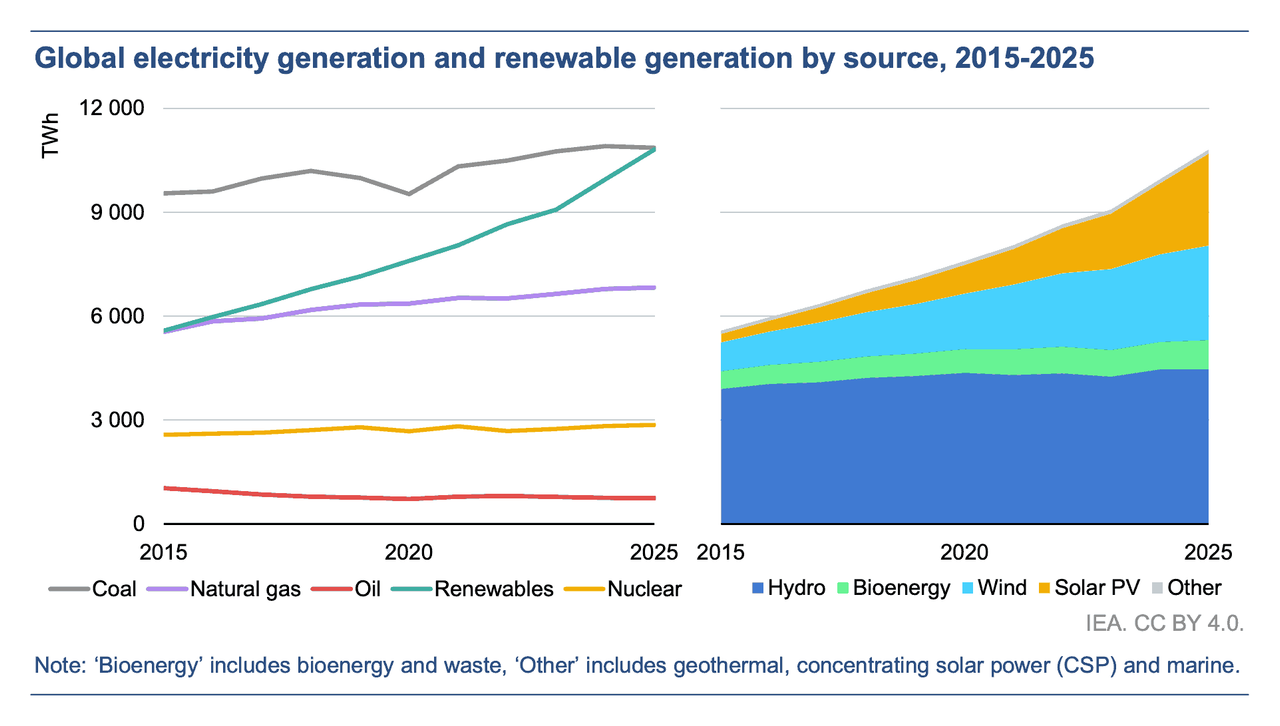
Global renewable generation increased by around 8.5% year-on-year in 2025, slightly slower than the 9.6% rise observed in 2024 but much faster than the around 6% average of the previous decade. This was despite declines in hydropower output in Europe and Eurasia and lower-than-normal wind speeds, particularly in Europe, which tempered growth. Solar PV saw its largest-ever increase in generation, rising by about 600 TWh. About 55% took place in China, but growth was otherwise broad-based geographically.
Annual nuclear generation reached a record high following strong growth in 2024. Output grew by 1.2% in 2025, the result of reactor restarts in Japan, the strong performance of plants in France, and new units that began operations in several countries.
Global coal-fired generation dipped slightly in 2025, following an increase of 1.4% in 2024. The slight decline was in part due to unusual regional patterns. Unlike in recent years, coal-fired electricity output fell in both China and India, while it rose in the United States and declined by less than expected in the European Union. 2025 marked the first time in five decades that China and India saw simultaneous declines. In China, strong growth in renewable and nuclear generation, coupled with slower electricity demand growth than in 2024, helped drive coal-fired output down. In India, coal use declined due to a rapid expansion of renewables and an early and strong monsoon, with renewables posting their largest-ever annual increase. In the United States, higher natural gas prices compared with 2024, strong demand growth and slower coal plant retirements pushed coal-fired generation higher. In the European Union, despite record solar PV output, weak wind and hydropower output resulted in higher gas-fired generation and a small decline in coal-fired generation.
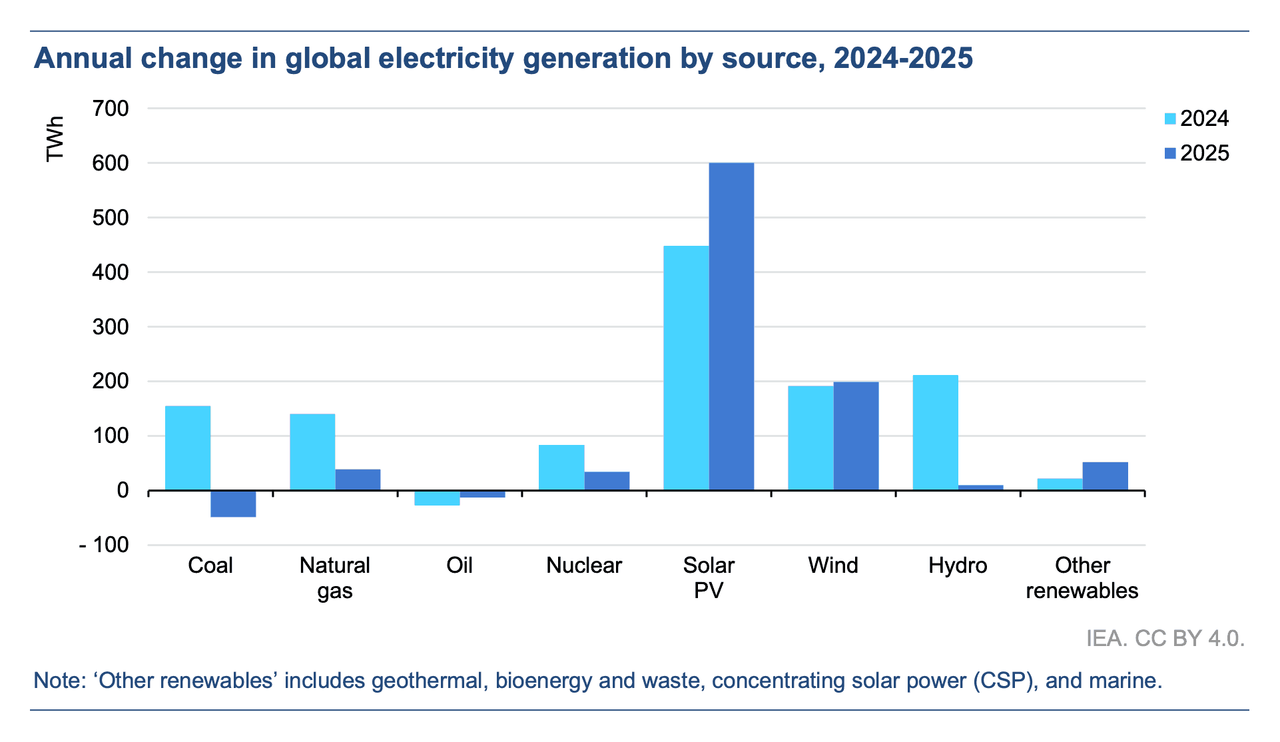
Global natural gas-fired generation increased by around 0.5% in 2025, following an increase of 2.1% in 2024. Gas-fired generation rose strongly in Europe as weather trends boosted demand for heating and cooling. It also increased in the Middle East due to oil-to-gas switching in the power sector, particularly in Saudi Arabia. Global growth was tempered by declines in the United States, where natural gas prices encouraged switching from gas to coal. Outside the Middle East, oil is also increasingly being replaced by renewables and natural gas. As a result, global oil-fired generation declined by around 1.5% in 2025.
Share of low-emissions generation at record high, but coal and gas remain largest sources of electricity
The global electricity generation mix saw a marked increase in power generated from low-emissions sources (renewables and nuclear), which reached 43% in 2025 – the highest level in the last fifty years. The share of renewables in global total electricity generation increased to 34% in 2025, up from 32% in 2024 and 23% a decade ago. The share of wind and solar PV generation together reached 17%, increasing from 15% in 2024, and up from about 5% just a decade ago. At the same time, coal remained the largest source of electricity, providing 34% of global generation. Natural gas was the second-largest source, accounting for 21% of the total.
In emerging market and developing economies such as China, India and Southeast Asia, coal remained the dominant source of electricity. Nevertheless, due to the rapid expansion of low-emissions sources, the share of coal-fired generation in China declined to 55% in 2025, down from 70% a decade ago. In India, it edged down to 71% in 2025 from 74% in 2024 and 76% back in 2015. In Southeast Asia, by contrast, the share of coal-fired generation remained at 48% in 2025, similar to its 2024 share, and up from 37% a decade ago. Renewables increased to 32% of electricity generation across emerging market and developing economies, while nuclear remained at close to 5%.
In advanced economies, renewables provided 36% of electricity generation in 2025, up slightly from the previous year and well above their 24% share a decade ago. Complemented by nuclear power, which accounted for 16%, low-emissions sources generated more than half of electricity in advanced economies in 2025. Among this group, the share of coal has been rapidly declining in recent years, falling from 30% in 2015 to around 16% in 2024 and stabilised at that level in 2025. In the European Union, planned coal phaseouts continued and the share of solar PV and wind reached 30% in 2025, surpassing that of fossil fuels for the first time. In the United Kingdom, which closed its last coal fired power station in 2024, the share of renewables grew to 55%. The United States saw an uptick in coal-fired generation in 2025, with its share rising to 17% from 16% in 2024 amid higher natural gas prices. Natural gas accounted for 40% of US generation in 2025, down from 42% in 2024 but still significantly higher than the 32% share seen a decade ago. In both the European Union and the United States, alongside renewables, nuclear energy continues to play an important role, covering 23% and 18% of generation, respectively.
IEA (2026), Global Energy Review 2026, IEA, Paris https://www.iea.org/reports/global-energy-review-2026, Licence: CC BY 4.0
 = new reply since forum marked as read
Highlight:
NoneDon't highlight anything
5 newestHighlight 5 most recent replies
= new reply since forum marked as read
Highlight:
NoneDon't highlight anything
5 newestHighlight 5 most recent replies

Finishline42
(1,165 posts)South Australia is one example but at less than 2 million how much impact do they have?
But then there's Pakistan, the 5th most populous country in the world. They are making a commitment to solar and have been making fairly large steps...
Link to tweet
?s=20

NNadir
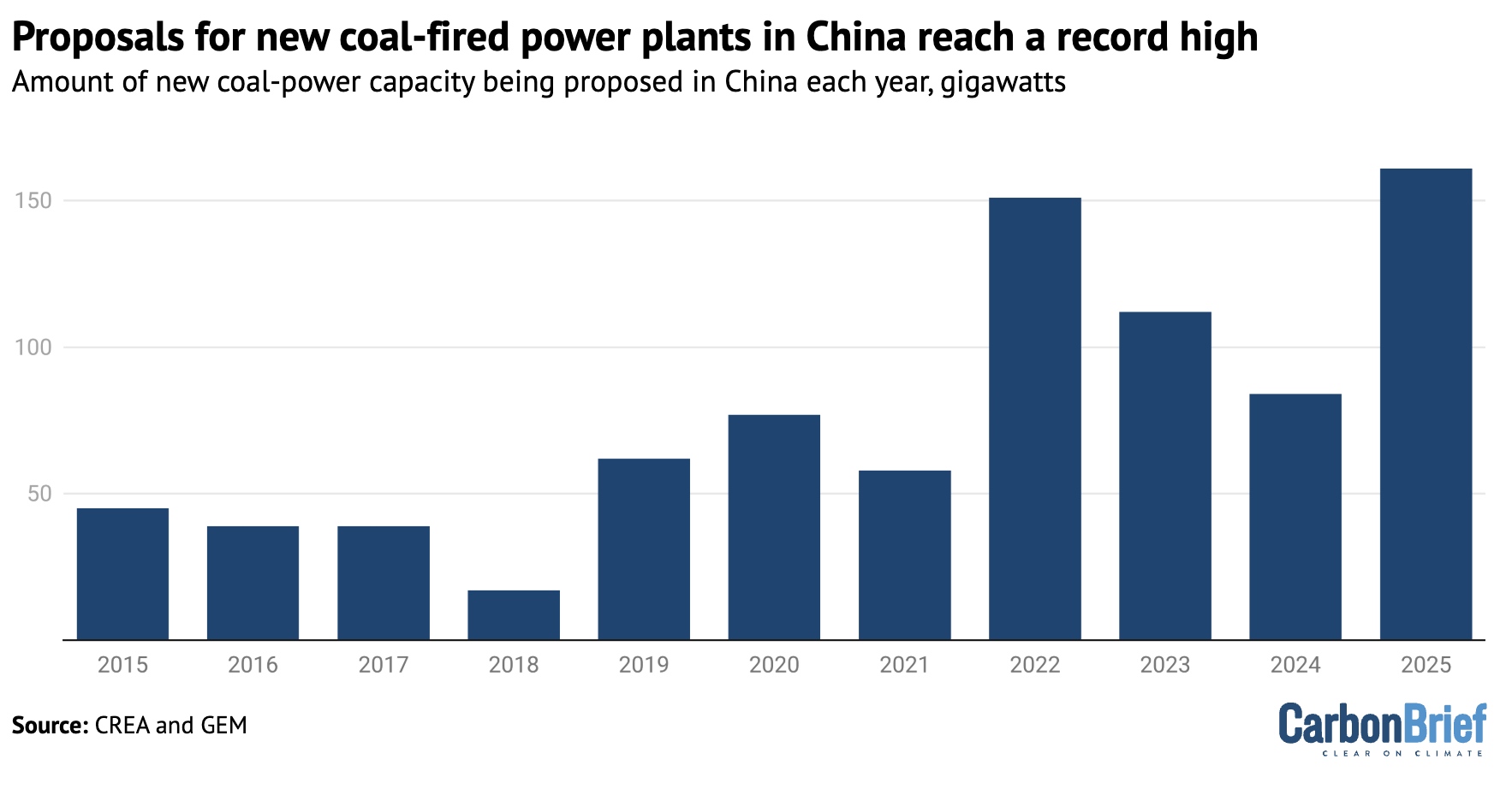
(38,308 posts)I wonder why it is, therefore, that China is building 95 coal plants as we speak.
‘Rush’ for new coal in China hits record high in 2025 as climate deadline looms
A graphic from that account from Climate Brief.
From Yale 360:
As It Boosts Renewables, China Still Can’t Break Its Coal Addiction
Subtitle:
Excerpt:
An attachment to coal? You don't say? In a renewable paradise?
I have the distinct impression, that the climate is collapsing faster than ever, although this week for the first time since 1997, a weekly reading decreased with respect to that of the previous year. Is it because the wind was blowing and the sun was shining, or was it because the Orange Pedophile stumbled into a war cutting world access to petroleum and gas?
I track these carbon figures weekly. From two weeks ago:
New Weekly CO2 Concentration Record Set at the Mauna Loa Observatory, 431.87 ppm
When I joined DU, in November of 2002, at the start of 24 years of "renewable energy" will save us" rhetoric it was 368.91 ppm.
When one is shutting a coal plant because the wind is blowing and the sun is shining, one has two options. One is to keep the steam up by continuing to burn coal, but not generating electricity, (which therefore doesn't appear in the accounting of generation) and the other is to burn coal for a few hours to bring the steam back up before one can generate a single watt of power.
So called "renewable energy" - which is not sustainable because of its land and material demands, and of course, its clear and obvious (everywhere on the fucking planet) dependence on access to fossil fuels.
It does not matter how much power is generated as it does when it is generated, and what is replacing it when it isn't replacing it.
In any case, on a little reflection, one can understand that given the short life time of renewable junk, it will reach a point at which it can only be built as fast as its falling apart. This is analogous to a famous equation in nuclear engineering called the Bateman Equation, which defines the maximum equilibrium value to which a radionuclide can accumulate before it is decaying as fast as it is formed, a function of power level:
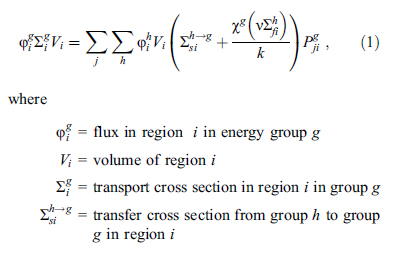
How much land must be littered with dysfunctional wind turbines and vast stretches of solar cells having become electronic waste, before the world capacity to build them is equal to the rate at which they fail?
The planet is burning. I have never met an apologist for the antinuke cults pushing so called "renewable energy" who isn't declaring victory in spite of this reality.
There isn't enough copper, lithium, cobalt, dysprosium and neodymium on the planet to get so called "renewable energy" to 20 EJ per year.
And there soon will not be enough water, given our failure to address the collapse of the planetary atmosphere, to get biomass to burn.
Great "percent talk" though. I'm sure all the hydrogen assholes and battery assholes will show up to cheer. Why in fact, I see they already have.
As for me, as always, I'm unimpressed with the apologists for continued fossil fuel dependence. Once again, in case the "renewables will save us" idiots missed it the first time: The planet is burning.
Have a wonderful day tomorrow.

thought crime
(1,700 posts)"China installed a record 300 gigawatts of solar power and 100 gigawatts of wind power last year, which meant that the continuing increase in China’s electricity demand was largely met by clean energy. "
That sounds like some good news. It's unfortunate that China is increasing coal use as well, but they're working to transition to clean energy. Approaching critical mass.