Environment & Energy
Related: About this forum
Some Aspects of the Fuel for the Energy Device with the Lowest Carbon Intensity Known.
The paper I'll discuss in this post, a long paper that I can only find time to discuss briefly, is this one:
Matthews, C., Unal, C., Galloway, J., Keiser, D. D., & Hayes, S. L. (2017). Fuel-Cladding Chemical Interaction in U-Pu-Zr Metallic Fuels: A Critical Review. Nuclear Technology, 198(3), 231–259.
The paper touches on two fission products I have discussed in earlier posts, one on 93Zr, which I discussed here:
Recent Advances in Cladding Material Extraction from Fuels in Nuclear Fuel Cycles...
...and...
107Pd which I discussed here:
Improved efficiency of selective photoionization of palladium isotopes via autoionizing Rydberg states.
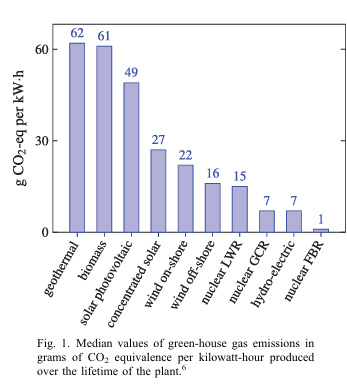
Because of the very high fuel utilization the reactor whose fuel is discussed here, a fast neutron reactor, has the lowest carbon dioxide intensity of any energy device, 1 gram CO2/kWh.
The comparison between the carbon intensity of energy devices is given in this figure, figure 1 of the paper:
Very few fast neutron breeder reactors now operate in the world, the two most successful examples being Russian reactors, BN-600, commissioned in 1980 and licensed to operate until 2040, and the BN-800, a larger version, commissioned in 2016.
These are sodium cooled reactors with two sodium heat exchangers, one of which is radioactive (containing traces of radioactive 24Na, with a half-life just under 15 hours and 23Na, the natural isotope, and one containing only the natural isotope of sodium, 24Na). These reactors produce more fissionable nuclear fuel than they consume: They are breeders.
India recently brought, earlier this month, its own breeder reactor to criticality. It is designed to produce plutonium and the fissile isotope 233U - which does not occur naturally, from thorium.
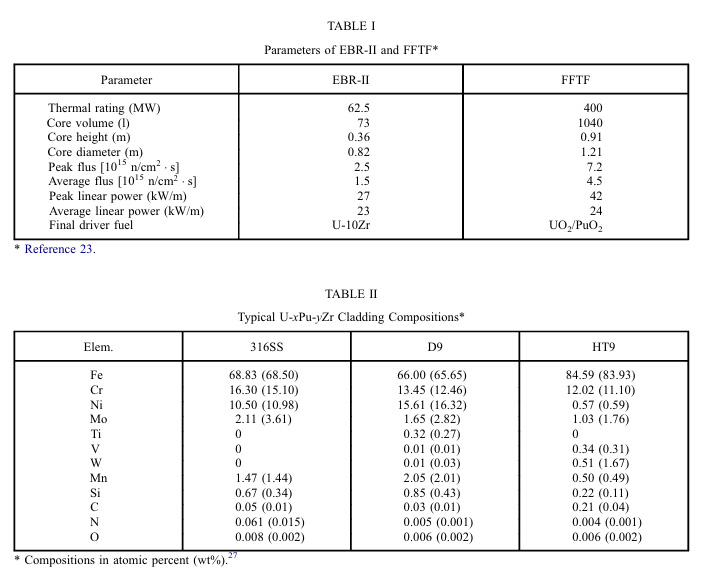
The information in this paper is based on the performance of the US EBRII, which operated from 1964 until 1994 at Argonne National Lab, powering the facility with about 20 MWe, and 65M(th) power having been built at a cost of $327 million dollars in 2025 dollars, ($32M in 1964 dollars).
The successor IFR program was cancelled in 1994, a damned shame.
From the text:
Figure 1 from the text:
https://i.postimg.cc/Sj0GfRW0/NT198(3)-231-259f1.jpg
Zirconium, which is both a manufacturing component and a fission product available from used nuclear fuel is used as diluent for uranium and plutonium in the fuel pellets, which are metallic.
Interestingly, the cladding contained iron, which forms a eutectic with plutonium, an intriguing feature exploited by the LAMPRE reactor which used liquid plutonium fuel in the 1960s, the liquid being an iron plutonium eutectic. (A ternary cobalt/cerium/plutonium eutectic was also considered, but was not tested in the LAMPRE reactor.) I'm fascinated by the LAMPRE, and trying to get it into my son's head, but the eutectic I would advise is the binary plutonium/neptunium eutectic.
The composition of the claddings used are shown in table 2 in the paper, shown here with table 1, giving the reactor properties:
The Pu/Fe eutectic is discussed in the paper:
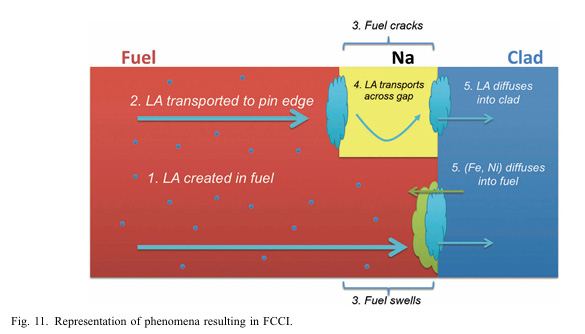
A figure in the paper considers the migration of lanthanides to the fuel pin periphery onto the cladding, and the simultaneous migration of iron into the fuel:
One possible mechanism to address this problem is doping the fuel with palladium, a fission product I discussed in the earlier post linked above.
This approach, were it to prove valuable would provide an excellent opportunity to expand the use of the odd palladium isotopes, 107Pd and 105Pd potentially isolated by exploiting Rydberg states described in my previous post. During this process, 107Pd would be transmuted into non-radioactive 108Pd; however new 107Pd would be generated by fission.
Interestingly, it appears that an issue with the fuel is the migration of lanthanide fission products to the edge of the fuel pellets; the solubility of cerium is discussed therein, as is the accumulation of neodymium. I can certainly imagine several benefits of this behavior, although it is clear from the paper that this migration was considered problematic.
There's quite a bit to ponder in this wonderful paper, but regrettably I won't have time for further discussion of the many interesting points therein.
I only have time to give a flavor.
The cancellation of the IFR program thirty years ago was a very bad mistake; unfortunately as American science is being decimated by ignoramuses, it will be difficult to correct that mistake in the next several years.
Have a nice evening.