Supreme Court will decide if preschools that decline children of same-sex couples may receive state funding
Source: CNN
Politics
Supreme Court will decide if preschools that decline children of same-sex couples may receive state funding
By John Fritze
Updated 1 hr 15 min ago
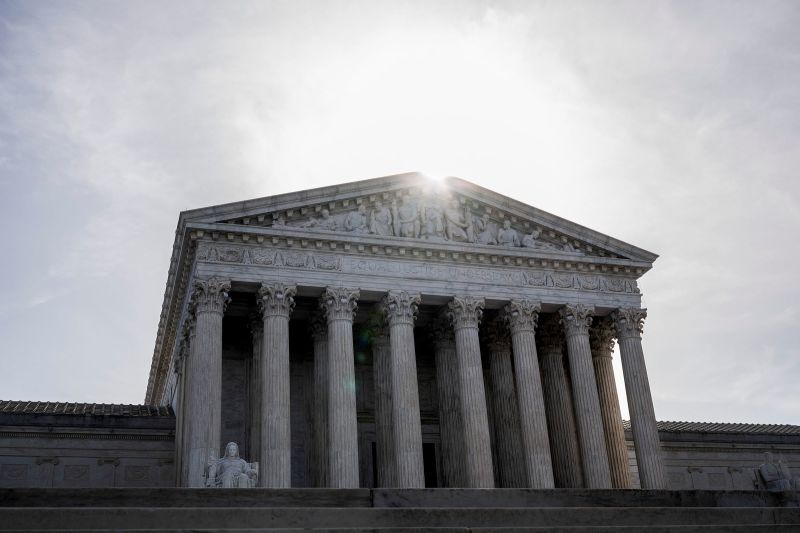
The sun rises above a facade of the US Supreme Court building in Washington, DC, on March 31, 2026. Roberto Schmidt/Getty Images
The Supreme Court agreed Monday to review a Colorado law that requires preschools receiving taxpayer money to enroll children of same-sex couples -- setting up an important First Amendment showdown at the high court that pits religious rights against LGBTQ families.
At the same time, the court declined to hear another high-profile case involving a Massachusetts couple who said their school began treating their middle school child as genderqueer against their wishes.
After years of allowing religious schools in some settings to receive state funding alongside secular schools, the 6-3 conservative court will now decide what to do when school leaders assert that anti-discrimination laws intended to protect gay and transgender people conflict with their religious beliefs. The appeal from the Catholic parishes will likely be heard in the fall and a decision is likely sometime next year.
Colorado enacted a ballot provision in 2020 that provides state funding for a universal preschool program, allowing both public and private schools to take part. The state program includes a nondiscrimination provision that requires each school receiving public money to provide eligible children an equal opportunity to enroll, regardless of race, religious affiliation, sexual orientation, gender identity and other factors.
{snip}
Read more: https://www.cnn.com/2026/04/20/politics/supreme-court-same-sex-couples-preschool
******
Chris Geidner
@chrisgeidner.bsky.social
BREAKING: The Supreme Court takes up two new cases for next term, including a case over Colorado's exclusion of Catholic preschools from public funding.
The case specifically [raised] a question the court has circled around for years: Whether 1990's Employment Division v. Smith should be overruled.
25-581
25-5343
CERTIORARI GRANTED
ST. MARY CATHOLIC PARISH, ET AL. V. ROY, LISA, ET AL.
The petition for a writ of certiorari is granted limited to
Questions 1 and 2 presented by the petition.
BEAIRD, KENDRICK J. V. UNITED STATES
The motion of petitioner for leave to proceed in forma
2
pauperis is granted. The petition for a writ of certiorari is granted limited to the following question: Whether Stinson v.
United States, 508 U. S. 36 (1993), still correctly states the
rule for the deference that courts must give the commentary to
the Sentencing Guidelines.
ALT
9:41 AM · Apr 20, 2026
******
BREAKING: The Supreme Court takes up two new cases for next term, including a case over Colorado’s exclusion of Catholic preschools from public funding.
— Chris Geidner (@chrisgeidner.bsky.social) 2026-04-20T13:41:55.222Z
The case specifically raises a question the court has circled around for years: Whether 1990’s Employment Division v. Smith should be overruled.
******
Chris Geidner
@chrisgeidner.bsky.social
Here is the full orders list: www.supremecourt.gov/orders/court...
https://www.supremecourt.gov/orders/courtorders/042026zor_h315.pdf
www.supremecourt.gov
9:44 AM · Apr 20, 2026
******
Here is the full orders list: www.supremecourt.gov/orders/court...
— Chris Geidner (@chrisgeidner.bsky.social) 2026-04-20T13:44:45.428Z
******
Chris Geidner
@chrisgeidner.bsky.social
Sorry for the confusion: I had meant the case "raised" that question, not "raises," because the Supreme Court cut the question -- and had intended to follow up with this to show that they cut that (but got distracted with arguments).
The court still is circling, was my point.
Apologies again!
The questions presented are:
1. Whether proving a lack of general applicability under Employment Division v. Smith requires showing unfettered discretion or categorical exemptions for identical secular conduct.
ii
2. Whether Carson v. Makin displaces the rule of Employment Division v. Smith only when the government explicitly excludes religious people and institutions.
3. Whether Employment Dwision v. Smith should be overruled.
ALT
10:29 AM · Apr 20, 2026
******
Sorry for the confusion: I had meant the case “raised†that question, not “raises,†because the Supreme Court cut the question — and had intended to follow up with this to show that they cut that (but got distracted with arguments).
— Chris Geidner (@chrisgeidner.bsky.social) 2026-04-20T14:29:45.367Z
The court still is circling, was my point.
Apologies again!
******
Chris Geidner
@chrisgeidner.bsky.social
Here's the cert petition, in which the Becket Fund is representing the parishes and others who sued over the exclusion:
https://www.supremecourt.gov/DocketPDF/25/25-581/384425/20251113161200771_No.-__Petition%20for%20a%20Writ%20of%20Certiorari.pdf
https://www.supremecourt.gov/DocketPDF/25/25-581/384425/20251113161200771_No.-__Petition%20for%20a%20Writ%20of%20Certiorari.pdf
www.supremecourt.gov
10:43 AM · Apr 20, 2026
******
Here’s the cert petition, in which the Becket Fund is representing the parishes and others who sued over the exclusion: www.supremecourt.gov/DocketPDF/25...
— Chris Geidner (@chrisgeidner.bsky.social) 2026-04-20T14:43:10.101Z
******
Erik of Portland, Governmental Lawlessness Disliker
@erikgunderson.bsky.social
Employment Division v. Smith was Scalia's best opinion. You don't get to escape the law simply because you are religious.
11:05 AM · Apr 20, 2026
******
Employment Division v. Smith was Scalia's best opinion. You don't get to escape the law simply because you are religious.
— Erik of Portland, Governmental Lawlessness Disliker (@erikgunderson.bsky.social) 2026-04-20T15:05:19.370Z
 = new reply since forum marked as read
Highlight:
NoneDon't highlight anything
5 newestHighlight 5 most recent replies
= new reply since forum marked as read
Highlight:
NoneDon't highlight anything
5 newestHighlight 5 most recent replies

bluestarone
(22,320 posts)As long as the constitution calls for SEPARATION of church and state, THEY should NOT be deciding anything vs religion. Any religious lawsuits against our citizens ( religion vs our constitutional rights) should be THROWN out!! NO SHADOW DOCKET bullshit!!! 

mahatmakanejeeves
(70,247 posts)
bucolic_frolic
(55,437 posts)What goes on in their distorted minds - religious beliefs which are best kept private - wind up as the law of the land to use the power of government to bend everyone to what's going on in their minds. Private thoughts for public harm. Done deal, it's obvious how they'll rule, why go through this exercise?
mahatmakanejeeves
(70,247 posts)Employment Division, Department of Human Resources of Oregon v. Smith, 494 U.S. 872 (1990), is landmark decision of the United States Supreme Court, where the Court held that the state could deny unemployment benefits to a person fired for violating a state prohibition on the use of peyote even though the use of the drug was part of a religious ritual. Although states have the power to accommodate otherwise illegal acts performed in pursuit of religious beliefs, they are not required to do so.
{snip}
Majority opinion
The majority opinion was delivered by Justice Antonin Scalia. The First Amendment forbids government from prohibiting the "free exercise" of religion. This means that government may not regulate beliefs as such, either by compelling certain beliefs or forbidding them. Religious belief frequently entails the performance of physical acts—assembling for worship, consumption of bread and wine, abstaining from certain foods or behaviors. Government could no more ban the performance of these physical acts when engaged in for religious reasons than it could ban the religious beliefs that compel those actions in the first place. "It would doubtless be unconstitutional, for example, to ban the casting of statues that are to be used for worship purposes or to prohibit bowing down before a golden calf."
But Oregon's ban on the possession of peyote is not a law specifically aimed at a physical act engaged in for a religious reason. Rather, it is a law that applies to everyone who might possess peyote, for whatever reason—a "neutral law of general applicability". Scalia characterized the employees' argument as an attempt to use their religious motivation to use peyote in order to place themselves beyond the reach of Oregon's neutral, generally applicable ban on possession of peyote. The Court held that the First Amendment's protection of the "free exercise" of religion does not allow a person to use a religious motivation as a reason not to obey such generally applicable laws. Citing Reynolds v. United States (1878), Scalia wrote, "To permit this would be to make the professed doctrines of religious belief superior to the law of the land, and in effect to permit every citizen to become a law unto himself." Thus, the Court had held that religious beliefs did not excuse people from complying with laws forbidding polygamy, child labor laws, Sunday closing laws, laws requiring citizens to register for Selective Service, or laws requiring the payment of Social Security taxes.
{snip}

Vinca
(54,149 posts)Why would the kid somehow be responsible for the parent's sexual orientation???????

wolfie001
(7,817 posts)


wolfie001
(7,817 posts)6 trumpian Klans people. 