Welcome to DU!
The truly grassroots left-of-center political community where regular people, not algorithms, drive the discussions and set the standards.
Join the community:
Create a free account
Support DU (and get rid of ads!):
Become a Star Member
Latest Breaking News
Editorials & Other Articles
General Discussion
The DU Lounge
All Forums
Issue Forums
Culture Forums
Alliance Forums
Region Forums
Support Forums
Help & Search
General Discussion
Related: Editorials & Other Articles, Issue Forums, Alliance Forums, Region ForumsSamuel Alito Had No Answers For Ketanji Brown Jackson's Latest Dissent
https://ballsandstrikes.org/scotus/samuel-alito-ketanji-brown-jackson-callais-dissent-no-answers/Jay Willis
The more transparently political the Court's work becomes, the more fiercely the conservative justices insist that there is nothing political about the Court's work.
Much leading and trailing material snipped. Please read the whole article for completeness.
. . .
Although Jackson did not spell it all the way out in her opinion, the implication is pretty clear: Then, Alito disapproved of judicial intervention when it would have harmed Republicans in Texas; now, he is greenlighting judicial intervention when it will harm Democrats in Louisiana. Then, Alito argued that under Purcell, a court should not interfere with a primary election scheduled to take place in three months; now, he is arguing that Purcell poses no obstacle to a court interfering with a primary election that is already in progress.
Jackson's dissent prompted Alito to write a concurring opinion that is more or less an angry blog post about how much Jackson had hurt his feelings. Joined by Justices Clarence Thomas and Neil Gorsuch, Alito gestures briefly at the fact that the 32-day waiting period is a "default" rule that the Court can set aside when circumstances warrant. But his real goal is to air out his grievances with Jackson, whose opinion, he says, "levels charges that cannot go unanswered." At various points, Alito refers to the thrust of her dissent--the simple observation that the Republican justices are selectively applying rules and precedents in ways that help Republican politicians win elections--as lacking "restraint," and as "groundless," "utterly irresponsible," and "baseless and insulting."
It is of course not new for Supreme Court justices to get snippy with each other in dueling opinions. But what is notable about Alito's rejoinder to Jackson--especially given his stated purpose of writing separately so as not to let her "charges" go "unanswered"--is how bereft it is of anything that even has the cadence of legal analysis. Perhaps the most telling passage comes in the second-to-last paragraph, when Alito asks, rhetorically, what "principle" Jackson believes the Court to have violated. Then, he offers two sarcastic possibilities: the "principle" that the Court should never shorten the 32-day period, and the "principle" that the Court "should never take any action that might unjustifiably be criticized as partisan."
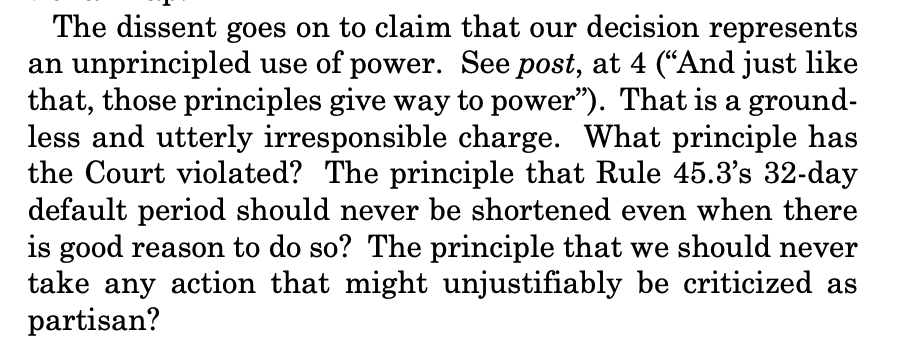
This is a weird question for him to frame as a gotcha, because, again, there is a real answer: In her opinion, Jackson details how the Court's choice in this case conflicts with its choices in Rucho, Purcell, and Abbott. But Alito does not respond to Jackson's point about Rucho, or assert that she is wrong about Purcell, or explain how his actions in Abbott and Callais can be reconciled. In fact, his opinion does not mention Purcell at all; he simply asserts that by having the temerity to disagree with him in public, Jackson is being very rude to him.
. . .
Although Jackson did not spell it all the way out in her opinion, the implication is pretty clear: Then, Alito disapproved of judicial intervention when it would have harmed Republicans in Texas; now, he is greenlighting judicial intervention when it will harm Democrats in Louisiana. Then, Alito argued that under Purcell, a court should not interfere with a primary election scheduled to take place in three months; now, he is arguing that Purcell poses no obstacle to a court interfering with a primary election that is already in progress.
"The Court unshackles itself from both constraints today and dives into the fray," Jackson concluded. "And just like that, those principles give way to power."
Jackson's dissent prompted Alito to write a concurring opinion that is more or less an angry blog post about how much Jackson had hurt his feelings. Joined by Justices Clarence Thomas and Neil Gorsuch, Alito gestures briefly at the fact that the 32-day waiting period is a "default" rule that the Court can set aside when circumstances warrant. But his real goal is to air out his grievances with Jackson, whose opinion, he says, "levels charges that cannot go unanswered." At various points, Alito refers to the thrust of her dissent--the simple observation that the Republican justices are selectively applying rules and precedents in ways that help Republican politicians win elections--as lacking "restraint," and as "groundless," "utterly irresponsible," and "baseless and insulting."
It is of course not new for Supreme Court justices to get snippy with each other in dueling opinions. But what is notable about Alito's rejoinder to Jackson--especially given his stated purpose of writing separately so as not to let her "charges" go "unanswered"--is how bereft it is of anything that even has the cadence of legal analysis. Perhaps the most telling passage comes in the second-to-last paragraph, when Alito asks, rhetorically, what "principle" Jackson believes the Court to have violated. Then, he offers two sarcastic possibilities: the "principle" that the Court should never shorten the 32-day period, and the "principle" that the Court "should never take any action that might unjustifiably be criticized as partisan."
This is a weird question for him to frame as a gotcha, because, again, there is a real answer: In her opinion, Jackson details how the Court's choice in this case conflicts with its choices in Rucho, Purcell, and Abbott. But Alito does not respond to Jackson's point about Rucho, or assert that she is wrong about Purcell, or explain how his actions in Abbott and Callais can be reconciled. In fact, his opinion does not mention Purcell at all; he simply asserts that by having the temerity to disagree with him in public, Jackson is being very rude to him.
. . .
9 replies
 = new reply since forum marked as read
Highlight:
NoneDon't highlight anything
5 newestHighlight 5 most recent replies
= new reply since forum marked as read
Highlight:
NoneDon't highlight anything
5 newestHighlight 5 most recent replies
= new reply since forum marked as read
Highlight:
NoneDon't highlight anything
5 newestHighlight 5 most recent replies
Samuel Alito Had No Answers For Ketanji Brown Jackson's Latest Dissent (Original Post)
erronis
11 hrs ago
OP
Ketanji Brown Jackson is not afraid of the pompous white bros (and their lil sister and Clarence.)
erronis
9 hrs ago
#3
"neither the facts nor the law are on his side. All he can do is pound the table and yell about it."
mountain grammy
8 hrs ago
#7
Deadline Legal Blog-Louisiana map order highlights splits within the court's GOP and Democratic wings
LetMyPeopleVote
3 hrs ago
#8

GiqueCee
(4,597 posts)1. The biggest bullies...
... are always the most petulant crybabies when someone calls them out. And it's telling that poor widdoo Sammie chose to aim his aggrieved vitriol at Jackson, the only Black woman on the Court. The other two Liberal women disagreed with him, too.

erronis
(24,404 posts)3. Ketanji Brown Jackson is not afraid of the pompous white bros (and their lil sister and Clarence.)
I'm coming to admire her more and more every time I read her comments.
themaguffin
(5,340 posts)2. I hope she tears into him more. What fucking bullshit. Sleazy assholes.

Spazito
(55,955 posts)4. What a whiny baby he is...
His widdle feefees are hurt.
Geez.

stage left
(3,339 posts)5. Hurt him some more, Ketanji!

FBaggins
(28,718 posts)6. 8-1 needs no answers
It's all the "gotcha" he needs when even the other two liberal justices won't join her dissent.
mountain grammy
(29,153 posts)7. "neither the facts nor the law are on his side. All he can do is pound the table and yell about it."
Good article.
LetMyPeopleVote
(181,503 posts)8. Deadline Legal Blog-Louisiana map order highlights splits within the court's GOP and Democratic wings
Justice Jackson was the lone dissenter, prompting a rebuke from Justices Alito, Thomas and Gorsuch in the voting rights litigation.
Link to tweet
https://www.ms.now/deadline-white-house/deadline-legal-blog/louisiana-map-order-supreme-court-jackson-alito
The Supreme Court’s 6-3 ruling last week in Louisiana v. Callais provided a predictable snapshot of how the justices line up in some of the most crucial cases. The decision, which struck down the state’s congressional map for wrongly taking race into account, was a clean split between the GOP appointees — all of whom were in the majority, led by Justice Samuel Alito — and the Democratic appointees, led by Justice Elena Kagan. Her dissent doubled as an obituary for the Voting Rights Act, arguing that Callais marked the “latest chapter in the majority’s now-completed demolition” of that landmark law.
But a subsequent order in the case, entered on Monday night, spotlights a murkier divide. Justice Ketanji Brown Jackson once again was the lone dissenter calling out the majority, prompting Alito to pen a pointed rebuke in turn.
While the Callais ruling itself is incredibly important for redistricting across the country going forward, the order that sparked their exchange is a procedural one whose practical significance remains to be seen. It sent the case back to the lower court it came from. Typically, that doesn’t happen until 32 days after the ruling. That standard lag time gives the losing party time to file a long-shot petition for rehearing. (It’s a long shot because granting such a petition would require the justices to consider reversing course on a ruling they just made.)...
In her dissent, Jackson accused her colleagues of having “spawned chaos in the State of Louisiana.”
She chided the majority for intervening rather than avoiding “the appearance of partiality” by applying the court’s normal rules. Noting that early primary voting was already underway, she recalled the court’s decision backing Texas’ map last year, in which the majority criticized a lower court for “improperly insert[ing] itself into an active primary campaign.” Jackson said the majority “unshackles itself” from “constraints today and dives into the fray. And just like that, those principles give way to power.” She called the court’s “abandon … unwarranted and unwise.”
That prompted a concurring opinion by Alito, joined by Justices Clarence Thomas and Neil Gorsuch, that said the dissent “levels charges that cannot go unanswered.” He called it “groundless and utterly irresponsible” for Jackson to accuse the majority of exercising its power in an unprincipled way.
“What principle has the Court violated?” Alito wondered. “The principle that Rule 45.3’s 32-day default period should never be shortened even when there is good reason to do so? The principle that we should never take any action that might unjustifiably be criticized as partisan?” He concluded that Jackson’s claim that the court “unshackles itself” from “constraints” shows that it’s her “rhetoric that lacks restraint.”.....
Notably, they got yet another opportunity to weigh in. On Tuesday, the voters who opposed the fast-tracking returned to the justices, asking them to reverse the order they issued Monday. The voters noted that the court justified Monday’s order by saying they hadn’t “expressed any intent to ask this Court to reconsider its judgment.” But the voters pointed back to their opposition filing that said they wanted “the opportunity to consider seeking rehearing.” To eliminate any doubt, they said in their motion Tuesday that they wanted to request rehearing.
Again, the practical significance of Monday’s order was unclear to begin with in terms of its effect on the midterms in Louisiana, where separate litigation is playing out in response to the GOP governor’s attempt to suspend the primary after voting had already begun. ....
But Tuesday’s motion meant the justices weren’t free of the litigation just yet. Though they may be now, at least with this chapter of the litigation, because on Wednesday, they denied the voters’ request to reopen the matter – this time without comment from any of the justices.
But a subsequent order in the case, entered on Monday night, spotlights a murkier divide. Justice Ketanji Brown Jackson once again was the lone dissenter calling out the majority, prompting Alito to pen a pointed rebuke in turn.
While the Callais ruling itself is incredibly important for redistricting across the country going forward, the order that sparked their exchange is a procedural one whose practical significance remains to be seen. It sent the case back to the lower court it came from. Typically, that doesn’t happen until 32 days after the ruling. That standard lag time gives the losing party time to file a long-shot petition for rehearing. (It’s a long shot because granting such a petition would require the justices to consider reversing course on a ruling they just made.)...
In her dissent, Jackson accused her colleagues of having “spawned chaos in the State of Louisiana.”
She chided the majority for intervening rather than avoiding “the appearance of partiality” by applying the court’s normal rules. Noting that early primary voting was already underway, she recalled the court’s decision backing Texas’ map last year, in which the majority criticized a lower court for “improperly insert[ing] itself into an active primary campaign.” Jackson said the majority “unshackles itself” from “constraints today and dives into the fray. And just like that, those principles give way to power.” She called the court’s “abandon … unwarranted and unwise.”
That prompted a concurring opinion by Alito, joined by Justices Clarence Thomas and Neil Gorsuch, that said the dissent “levels charges that cannot go unanswered.” He called it “groundless and utterly irresponsible” for Jackson to accuse the majority of exercising its power in an unprincipled way.
“What principle has the Court violated?” Alito wondered. “The principle that Rule 45.3’s 32-day default period should never be shortened even when there is good reason to do so? The principle that we should never take any action that might unjustifiably be criticized as partisan?” He concluded that Jackson’s claim that the court “unshackles itself” from “constraints” shows that it’s her “rhetoric that lacks restraint.”.....
Notably, they got yet another opportunity to weigh in. On Tuesday, the voters who opposed the fast-tracking returned to the justices, asking them to reverse the order they issued Monday. The voters noted that the court justified Monday’s order by saying they hadn’t “expressed any intent to ask this Court to reconsider its judgment.” But the voters pointed back to their opposition filing that said they wanted “the opportunity to consider seeking rehearing.” To eliminate any doubt, they said in their motion Tuesday that they wanted to request rehearing.
Again, the practical significance of Monday’s order was unclear to begin with in terms of its effect on the midterms in Louisiana, where separate litigation is playing out in response to the GOP governor’s attempt to suspend the primary after voting had already begun. ....
But Tuesday’s motion meant the justices weren’t free of the litigation just yet. Though they may be now, at least with this chapter of the litigation, because on Wednesday, they denied the voters’ request to reopen the matter – this time without comment from any of the justices.
Jackson's dissent was great and hurt Alito's feelings. Alito is a racist who bent the rules to allow Louisiana to change the electoral maps even after votes had been casted. Alito is a racist asshole
erronis
(24,404 posts)9. Thanks for that excellent addition. The dynamics among the three non-racist Justices has to be interesting.