General Discussion
Related: Editorials & Other Articles, Issue Forums, Alliance Forums, Region Forums
Why I'm not happy with the AP's decision to support capitalizing "black."
I've never been happy with this change, but I've finally figured out why. It's because you have to be "in the know" to understand the rationale. Unlike the move from "girl" to "woman," which was intuitively obvious. This just raises the question, 'Well why not "white?" ' There's an answer, sure, but it requires thought and a sense of social history, and... and... Just the kind of thing that causes people to have animosity toward educated "elite." When I see black captalized in a book of fiction (as it is all the time, now), I think, "Yeah, and who decided this?" I'm sure it's prevalence is due to the AP's putting it in their style guide.
I was prompted to think about this today when I read a 2026 book by James Lee Burke that did not capitalize it. He has enough professional heft to say "no" to his publisher.
"AP’s style is now to capitalize Black in a racial, ethnic or cultural sense, conveying an essential and shared sense of history, identity and community among people who identify as Black, including those in the African diaspora and within Africa. The lowercase black is a color, not a person. AP style will continue to lowercase the term white in racial, ethnic and cultural senses."
 = new reply since forum marked as read
Highlight:
NoneDon't highlight anything
5 newestHighlight 5 most recent replies
= new reply since forum marked as read
Highlight:
NoneDon't highlight anything
5 newestHighlight 5 most recent replies

hlthe2b
(114,063 posts)I can sort of remember the seeming change from use of African American (always and always capitalized because it represents a people-- a distinct racial group of Americans, just as one would capitalize any other group) to the accepted alternative, Black or Black people-- then black is no longer just a skin color. Granted, African Americans are not the only black people in this country, so there is an argument to made either way. I would presume AP's editors have spent considerable time consulting with focus groups and representatives at the community, academic, political levels. Arguably, capitalizing "WHITE" doesn't make a lot of sense since it is no more than a perceived grouping of skin color and a mishmash of races and ethnicities.
At any rate, I guess time will tell how this shakes out. I've long depended on the AP style guidelines for writing within my own profession so I'd love to see this settled one way or another.
Response to hlthe2b (Reply #1)
Name removed Message auto-removed

Mme. Defarge
(9,030 posts)I’m working on a third manuscript in an unpublished mystery series - for me, fiction writing is a cheap hobby, more so than knitting - and I was reluctant to use Black instead of black. Now I will follow his example!

demmiblue
(39,763 posts)
magicarpet
(18,609 posts)...black people should be referred to as Black people, and equally white people referred to as White people.
It is in recognition of the dignity and respect of the human person as they are so entitled to.
Also too,.. black people have been too long handed the shit end of the societal stick. To make amends for all that injurious conduct, addressing them as Black people in written format is not too much to ask.
This comes from a White Caucasian person of Middle Eastern heritage and descent. Armenian to be specific.

WhiskeyGrinder
(26,983 posts)WhiskeyGrinder
(26,983 posts)Unlikely. Publishing houses have their own style and it's generally not based on AP style.
Response to LAS14 (Original post)
Name removed Message auto-removed

Skittles
(171,893 posts)

Celerity
(54,506 posts)

We are today making an important change to AP style that stems from a long and fruitful conversation among news leaders, editors and diverse members of our staff and external groups and organizations.
https://www.ap.org/the-definitive-source/announcements/the-decision-to-capitalize-black/
AP’s style is now to capitalize Black in a racial, ethnic or cultural sense, conveying an essential and shared sense of history, identity and community among people who identify as Black, including those in the African diaspora and within Africa. The lowercase black is a color, not a person. We also now capitalize Indigenous in reference to original inhabitants of a place. These changes align with long-standing capitalization of other racial and ethnic identifiers such as Latino, Asian American and Native American. Our discussions on style and language consider many points, including the need to be inclusive and respectful in our storytelling and the evolution of language.
We believe this change serves those ends. As a global news organization, we are continuing to discuss within the U.S. and internationally whether to capitalize the term white. Considerations are many and include any implications that doing so might have outside the United States. We continue to discuss other terms, including minorities and people of color, as well as the term “Black, Indigenous and people of color.” Our revisions come after more than two years of in-depth research and discussion with colleagues and respected thinkers from a diversity of backgrounds, both within and from outside the cooperative. The updates become part of the AP Stylebook’s race-related coverage guidance, which begins:
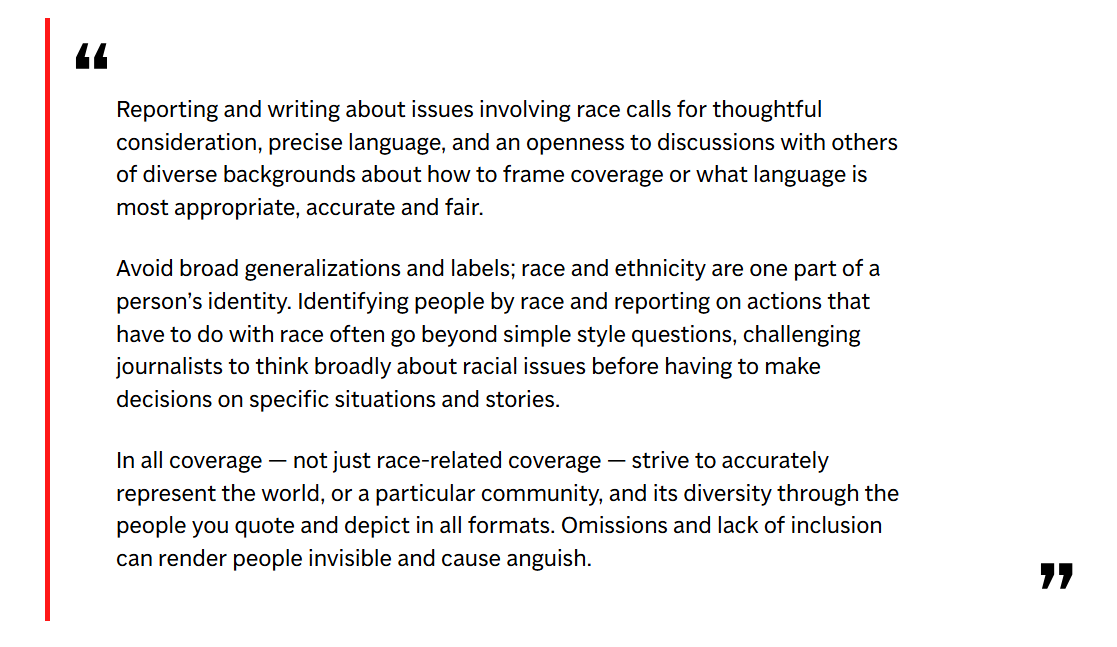
snip

MineralMan
(151,345 posts)publications, from magazines and newspapers to book publishers. Every one of the publications or publishers had a style sheet. Many of those were quite long and complex. If a writer wants to work for a publisher, following its style sheet is the best way to avoid conflicts. Style sheets change over time. It's up to the writers to pay attention to those changes and follow the publisher's style sheet. If you didn't do that, someone had to fix what you wrote. If they have to do that, it's annoying to them. If you make habit of it, you'll find yourself with fewer and fewer assignments for work.
One of the most common things that changed over time were issues like the one you raise. Why did they change? Because readers told them they wanted the changes. Publishers have to please their readers and writers have to please their publishers. From time to time, you'd get something that informed you of changes in the style sheet. If you were smart, you noted those changes and altered how your writings looked in terms of those changes.
Did some of the changes annoy me? Why, yes, they did, and not infrequently. Did I refuse to follow the style sheet? I did not. Occasionally, I'd have a discussion with my editor or the copy editors about style sheet issues. A couple of times, I instigated changes by pointing out changes in how words and concepts were being handled by other publications. Mostly, though, I wrote my articles and followed the style sheet used by the publisher for which I was writing.
Long ago, I stopped believing that I, alone, had the right way to say everything. There is no universal right way. Now, the word Black gets capitalized when it has to do with race identification. No big deal. White doesn't get the same treatment. Again, no big deal. If I'm troubled by that, I can write around the word and avoid the issue altogether. Mostly, though, I just followed the style sheet. 
If you don't like the publication's style, that's unfortunate. You could always write for someone else if it was that important to you. Most often it wasn't, though.
Anyhow, unless you do write for publication, you don't have to pay any attention to it at all. So, in the end, it doesn't matter, does it?

Emrys
(9,137 posts)I can't think of a publisher I've worked with for quite a few years that has had a hard-and-fast rule about this issue (and many others).
We generally follow the author's preferences (more and more publishers do this nowadays rather than having a rigid house style, the main aims being consistency and minimizing the need for editorial changes), which may have ideological reasons behind them, and make sure the usages are consistent. Similarly with white, though there's a logical argument that if one term has an initial cap, the other would too.

yardwork
(69,392 posts)Every time I do it I know it will annoy a fellow white person.
I think of it as a tiny but meaningful protest against the racism that pervades our nation and prevents us from having so many good things.